G-B budget and overall economy
“The Gilgit-Baltistan (G-B) government presented a delayed full-year budget of Rs218.845 billion for fiscal year 2026-27 on Tuesday. The budget carries a deficit of more than Rs52 billion and the gover…”
In July, the G-B government had presented an interim budget of Rs20.478 billion for the first quarter of FY27 and said the full-year budget would be presented after three months. Senior Minister Mohammad Ali Akhtar, who also holds the finance portfolio, presented the budget in the G-B Assembly.
Akhtar said the elected government had assumed office at the end of June 2026. Since only limited time was available between the end of the previous financial year and the start of the new one, the government had to ensure continuity and timely essential spending.
He said the government preferred to take time with the full-year budget so it could reflect the genuine needs, priorities and aspirations of the people. The total budget is estimated at Rs218.845 billion, with Rs43.97 billion for development and Rs149.87 billion for non-development expenditure.
"Stay connected with Aman-e-Pakistan for ongoing live reporting and verified investigative updates."
Tax revenues are targeted at Rs16.98 billion, while efforts are underway to secure federal funds to meet the budget deficit of Rs52.65 billion. The size of the Annual Development Plan was increased from Rs22 billion to Rs23 billion, while the amount allocated under the federal Public Sector Development Programme was increased from Rs15 billion to Rs20.973 billion.
Wheat subsidy fund, which had been reduced to Rs15 billion, was raised to Rs22 billion. Estimated revenue from wheat sales was Rs3 billion. G-B has requested a special stabilisation package of around Rs153.30 billion from the federal government for economic and administrative stability.
The package covers local government stability, law and order, education, health, tourism, flood compensation, municipal services, food supply, e-governance, agriculture, climate change, institutional capacity building and various liabilities. Akhtar said 1% of development funds would now be diverted to a consolidated climate account and non-development budgets of all departments would be reduced by 30%.
Substantial allocations were made for health, education and agriculture. These included an additional Rs170 million for medicines and a health endowment fund, Rs50 million for water management and Rs50 million for agriculture-sector reforms. Another Rs50 million each was allocated for youth loans, local bodies' elections and renovation of local bodies' offices.
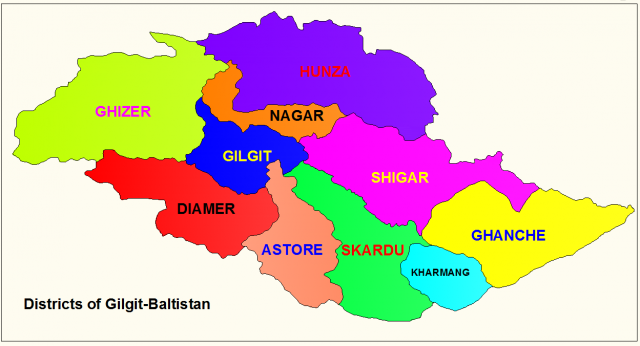
About Rs78 million was allocated for the water and power department and Rs18 million for tourism. Development projects in 10 districts received Rs5.034 billion. The numbers, however, raise a broader question: where does a Rs218.845 billion budget fit into Pakistan's wider economic structure?
The answer lies less in its headline size than in its composition. Development expenditure of Rs43.97 billion is substantially smaller than non-development spending of Rs149.87 billion. This leaves limited fiscal space for building infrastructure and productive capacity capable of expanding G-B's own economic and revenue base.
The revenue side highlights the structural problem. Against expenditure of more than Rs200 billion, the tax revenue target is only Rs16.98 billion. The resulting gap has to be covered largely through federal assistance.
The requested Rs52.65 billion for the budget deficit and the much larger stabilisation package underline the region's dependence on Islamabad. This reflects a broader feature of Pakistan's public finances. Regions with a narrow taxable economic base have limited capacity to finance public services from their own revenues, while the federal government itself faces substantial fiscal pressures.
For G-B, the longer-term challenge is therefore to convert public expenditure into productive economic activity. Tourism, hydropower, agriculture, mining and information technology offer potential avenues for expanding the economic base. But natural advantages alone do not automatically translate into employment or fiscal revenue.
Infrastructure, energy, skills, connectivity and institutional capacity are equally important. Tourism is perhaps the most visible opportunity. G-B's mountains, valleys and cultural heritage give it a distinctive advantage, but inadequate infrastructure, seasonality and environmental pressures can limit its contribution.
Sustained investment and better planning are needed if tourism is to generate a larger and more stable economic return. Hydropower presents another opportunity. The region possesses substantial water resources, but converting that potential into economic value requires investment in generation, transmission and supporting infrastructure, along with clear arrangements for financing and revenue sharing.
Agriculture and small-scale enterprise can also contribute. Allocations for water management, agricultural reforms and youth loans are modest relative to the overall budget, but their economic impact could be greater if linked to productivity, market access and employment.
The decision to cut non-development budgets by 30% is significant as a fiscal objective. If implemented effectively, savings from administrative expenditure could create additional room for development. But expenditure reduction needs to be accompanied by better management so that essential services are not weakened.
The climate allocation is also relevant. G-B's geography leaves its infrastructure and communities exposed to climate-related risks. Setting aside 1% of development funds for climate-related purposes could provide a more systematic source of financing for adaptation, provided the funds are directed towards clearly defined projects.
The wheat subsidy presents another policy challenge. Raising the allocation to Rs22 billion provides support to consumers, but subsidies also carry an opportunity cost. The longer-term issue is whether such support can be made more targeted and efficient while protecting the vulnerable households.
For Islamabad, the G-B budget represents both a fiscal obligation and an economic opportunity. Federal transfers are necessary to maintain public services and development in a geographically remote region with a limited revenue base. But recurring assistance without a corresponding expansion of economic activity can leave the region dependent on the federal exchequer.
The writer is a Mechanical Engineer
Continue Reading: More in National
Swipe or click arrows to explore National desk coverage