Istanbul huddle sets Makkah pact in motion
“The first high-level meeting under the landmark Makkah Joint Defence Agreement among Pakistan, Saudi Arabia and Turkiye will be held in Istanbul on Monday (today), marking the formal beginning of the …”
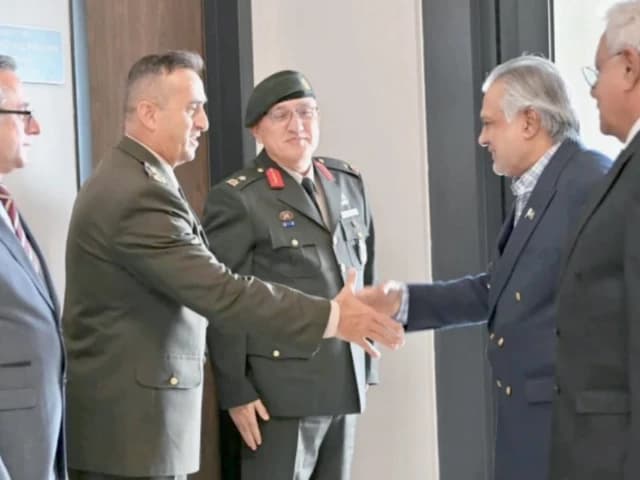
The meeting of the Strategic Political and Defence Committee established under the agreement will bring together foreign and defence ministers as well as military chiefs from the three countries.
Turkiye's Foreign Ministry said Foreign Minister Hakan Fidan, National Defence Minister Yasar Guler and Chief of the Turkish General Staff General Selcuk Bayraktaroglu would participate in the meeting along with officials from Pakistan and Saudi Arabia.
Pakistan will be represented by Deputy Prime Minister and Foreign Minister Ishaq Dar, Defence Minister Khawaja Asif, and Chief of Army Staff & Chief of Defence Forces Field Marshal Syed Asim Munir, the Foreign Office.
"Stay connected with Aman-e-Pakistan for ongoing live reporting and verified investigative updates."
"Pakistan's participation in the meeting signifies Pakistan's historic bonds of friendship with the brotherly countries of Turkiye and Saudi Arabia, as well as its desire for lasting regional peace and stability," the Foreign Office spokesperson said in the statement. The Foreign Office also said that Deputy Prime Minister Dar arrived in Istanbul, on Sunday "for official engagements".
Field Marshal Asim Munir also reached Istanbul on an "official visit", -Services Public Relations (ISPR). The Istanbul meeting is the first concrete institutional step towards implementing the Makkah Joint Defence Agreement, signed by Pakistan, Saudi Arabia and Turkiye on August 7 in the holy city of Makkah.
The agreement provides that an armed attack against any of the three countries would be regarded as an attack against all three, creating a collective defence commitment similar in principle to Article 5 of the NATO treaty. The three countries have described the arrangement as defensive and aimed at strengthening collective deterrence, rather than targeting any particular country.
Turkish Foreign Minister Fidan has specifically stressed that the agreement was not directed against Iran or any other state. He has also said that the pact was discussed before the latest escalation in the region, although the rapidly changing security environment has added urgency to closer coordination among the three countries.
The Istanbul meeting, therefore, assumes significance beyond its formal agenda. It will provide an opportunity for the three partners to begin translating the political commitment made in Makkah into an operational framework. Defence cooperation, military coordination, intelligence sharing, interoperability and defence production are expected to be among the areas requiring greater coordination.
The agreement itself calls for enhanced cooperation across various aspects of defence. For Pakistan, the new arrangement represents a further deepening of its already close defence relationship with both Saudi Arabia and Turkiye.
Pakistan has longstanding military ties with Saudi Arabia, including training and defence cooperation, while its relationship with Turkiye has expanded rapidly in recent years, particularly in defence production, naval cooperation and military technology. The three countries also bring different strategic strengths to the table.
Turkiye is a major regional military power and a NATO member with an increasingly sophisticated indigenous defence industry. Pakistan possesses one of the region's largest conventional military forces and is the only nuclear-armed Muslim-majority country.
Saudi Arabia, meanwhile, brings considerable financial resources and strategic weight as the leading Gulf power and one of the world's major energy producers. The combination has generated considerable international attention, with some observers describing the arrangement as a potential new regional security architecture.
Analysts, however, caution against immediately equating the Makkah pact with NATO, as the precise military obligations and mechanisms for responding to an attack remain to be developed. The timing of the agreement is also important.
It comes at a moment when the security architecture of the Middle East is undergoing profound changes. The prolonged US-Israeli conflict with Iran has exposed vulnerabilities in the Gulf and raised fresh questions among regional states about the reliability of existing security arrangements.
The Makkah agreement consequently reflects an emerging desire among key Muslim countries to strengthen their own collective security capabilities while maintaining their existing international partnerships. For Saudi Arabia, closer defence cooperation with Turkiye and Pakistan provides additional strategic depth at a time of heightened regional uncertainty.
For Turkiye, the pact reinforces its role as a major security actor in the Muslim world. For Pakistan, it offers an opportunity to expand its strategic and defence partnerships while positioning itself as an important player in the evolving security architecture of the wider region.
The agreement has also generated interest from other Muslim-majority countries. Bangladesh, for instance, is considering whether to join the arrangement, underlining the possibility that the framework could eventually expand beyond its three founding members. The Istanbul meeting will thus be closely watched for signs of how far the three countries intend to take the initiative.
More importantly, it could offer the first indication of whether the Makkah agreement will remain primarily a political declaration of solidarity or evolve into a functioning collective defence mechanism capable of shaping the strategic balance in the Middle East and beyond.
Written by Saba Qamar
Aman-e-Pakistan Senior Journalist & Bureau Reporter
Continue Reading: More in International
Swipe or click arrows to explore International desk coverage