Blank promises
“Back to Tribune. HomeT-Magazine. Blank promisesT-Magazine. Next Story. Blank promises. Marriage registration leaves women’s rights to chance. ByRAZZAk ABRO/Wisal Yousafzai/Muhammad Ilyas|Photo: AI Generatedfacebo…”
Back to Tribune. HomeT-Magazine. Blank promisesT-Magazine. Next Story. Blank promises. Marriage registration leaves women’s rights to chance. ByRAZZAk ABRO/Wisal Yousafzai/Muhammad Ilyas|Photo: AI GeneratedfacebooktwitterwhatsuplinkdedemailPUBLISHED
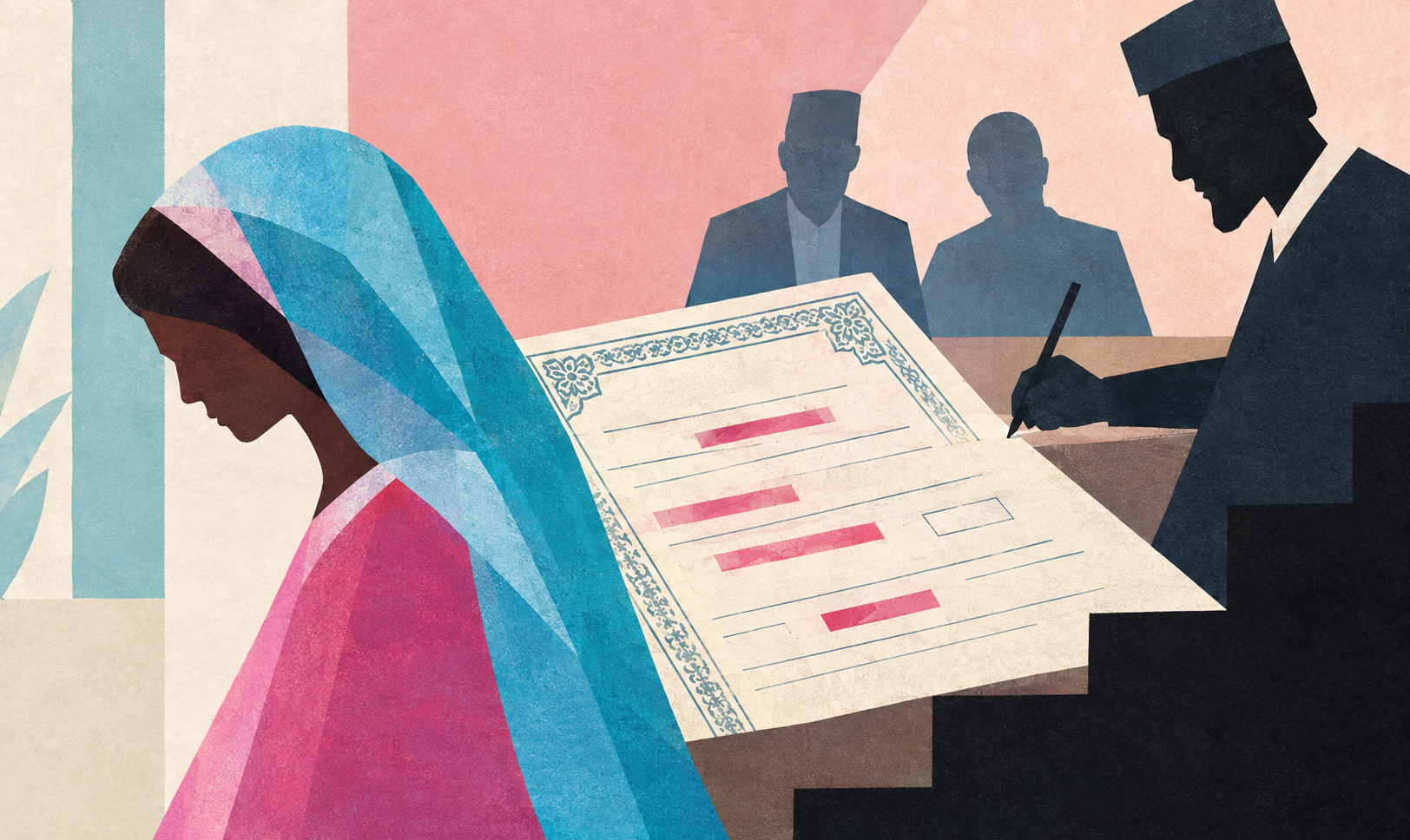
October 04, 2026A Nikahnama may take minutes to sign, but its fine print can shape a woman’s rights for decades.
Yet crucial clauses on haq mehr, property and delegated divorce are often left blank, crossed out or poorly filled — sometimes by Nikah khawans with little formal training in the law they are recording.
"Stay connected with Aman-e-Pakistan for ongoing live reporting and verified investigative updates."
The problem is particularly acute in rural and remote areas, where local familiarity often takes precedence over formal qualifications and families sign without fully understanding the Nikahnama’s legal weight. In such a scenario, computerisation can preserve a record, but it cannot make an incomplete or inaccurate entry meaningful.
The weakness becomes particularly significant in Khyber-Pakhtunkhwa (K-P), where incomplete marriage documentation intersects with the continuing problem of child marriage. Lawyers and child rights activists say that when the age and identity of a bride are not properly verified, registration can fail to identify an underage marriage before it takes place.
Peshawar High Court advocate Aisha Khan said the Nikahnama remains one of the most important legal documents for protecting women’s rights, but its effectiveness depends on the accuracy and completeness of the information recorded at the time of marriage.
Khan said K-P uses Form II of the Nikahnama under the Muslim Family Laws Ordinance and Rules, while the province amended the form in 2023 to include additional particulars concerning dower and the Khatm-e-Nabuwat declaration.
However, she noted that the continued use of unofficial Urdu translations alongside the official federal form, which is in English, can create inconsistencies in the recording and understanding of important marriage details. This becomes particularly problematic when couples do not understand the legal terminology used in the contract.
The difficulty is most evident in entries concerning age, identity, dower and property. Khan noted that accurate age and CNIC information was essential for identifying the parties and detecting potential underage marriages, while complete details of haq mehr and property could later determine whether a woman was able to establish her financial claims.
Columns 13 to 16 deal specifically with dower. Column 13 records its amount, Column 14 specifies whether it is prompt or deferred, Column 15 records the amount paid at the time of marriage, while Column 16 covers property given as dower, including its description and valuation.
Columns 17, 18 and 19 deal with special conditions, delegated power of divorce to the wife and restrictions on the husband's right of divorce, while Column 21 concerns an existing wife and permission from the Arbitration Council for another marriage. Yet these provisions are not always completed with the same care.
Khan explained that the absence of a standardised official Urdu version had created particular difficulties in Columns 13 to 16. In some cases, registrars record only the cash component of dower, while descriptions of immovable property remain vague or incomplete.
Such omissions may appear insignificant when a marriage is taking place but can become critical when a woman later approaches a family court to recover her dower or establish her entitlement to property. The problem, however, extends beyond K-P.In Sindh, the difference between urban and rural registration practices is also reflected in the qualifications expected of Nikah khawans.
Nazir Ahmed, secretary of an urban union council in Karachi, said a Nikah registrar seeking registration with them must have graduated from a major religious seminary. In rural areas, however, Abdul Sattar Jokhio, a former union council chairman, shared that the approach was different.
In villages, everyone knows the local cleric who solemnises marriages. Therefore, the union council does not require the cleric to produce a certificate or qualification from a religious seminary. That disparity raises questions about who is entrusted with completing a document carrying potentially significant legal consequences.
Local lawyer Muhammad Ismail Mayo Rajput said people from urban areas or better-educated families generally consider it important to have the relevant Nikahnama columns completed when arranging their children's marriages. In rural and less-educated families, on the other hand, the provisions were more likely to be left blank.
“Filling out most of these columns is particularly in the interests of brides and women, as it can prevent difficulties for them in the future,” he said. He pointed to delegated divorce as one example.
Where the wife has been given that right and the provision has been properly recorded, she can exercise the delegated right rather than having to approach a court for khula in the same way. Completing the dower provisions, he added, was similarly important to protecting a woman's financial rights.
In Punjab, legal expert Abdullah Malik raised similar concerns over the way dower is recorded. "Column 13 concerns haq mehr, a right of every woman, but registrars sometimes write only “Shariah” instead of specifying an amount.
" He also highlighted the failure to distinguish between mu’ajjal, or prompt dower, and ghair mu’ajjal, or deferred dower, saying this could create additional difficulties for women seeking to recover their entitlement. Malik said Columns 17, 18 and 19 were also sometimes crossed out, potentially preventing special conditions and delegated divorce rights from being properly recorded.
The problem, therefore, is not simply that a few registrars make mistakes. Pakistan lacks a consistently implemented system under which every Nikahnama is completed, explained and verified. Legal experts and rights activists say standardisation must extend beyond the form itself to the qualifications, training and monitoring of the people authorised to complete it.
In K-P, marriage registrars are required under provincial rules to meet certain eligibility criteria, and marriages are subsequently entered into a computer system using NADRA-linked software. But Khan cautioned that computerisation alone could not guarantee accurate registration.
“If a registrar enters an incorrect age, identity detail or dower amount without verifying the supporting documents,” the digital system simply creates a more efficient record of inaccurate information. That limitation becomes especially serious in relation to child marriage.
Qamar Naseem, programme manager at an organisation that works to empower women in K-P, said marriage registration should be digitally connected with birth-registration and national identity systems so that age verification becomes an institutional safeguard rather than something dependent on an individual registrar.
“A credible marriage registration system should not depend simply upon an age written by hand on a form,” he said. For K-P, where girls below the applicable legal age can still face marriage, such verification is critical.
A registrar who merely transfers an age supplied by a family onto a form may miss a legal problem that could have been identified through proper documentation. Naseem also said incomplete or ambiguous Nikahnamas place an avoidable burden on the justice system because family courts may later have to determine what the parties actually intended when the marriage took place.
The lack of awareness among couples further compounds the problem. Advocate Mehwish Mohib Kakhel said even educated couples sometimes sign the Nikahnama without reading or understanding its contents. “If people read this important document carefully, many issues concerning their rights and obligations can be clarified before marriage,” she said.
She stressed that the Nikahnama should not be treated as a routine formality. Properly completing and explaining it can provide greater protection for women while also helping prevent child marriage by ensuring that the age and identity of both parties were properly documented.
The responsibility, however, cannot rest with families alone. What is needed is a system in which Nikah khawans are properly qualified, regularly trained and held accountable for every entry they make. A standardised Nikahnama, clear language, routine inspection of registers and mandatory verification of age and identity could close some of the gaps that currently undermine marriage registration.
For women, the consequences can extend far beyond the wedding day. A blank dower column can complicate a financial claim; an omitted condition can become difficult to prove; and an unchecked age can allow an underage marriage to pass through a system designed to prevent it.
A marriage may be solemnised in minutes, but the words written — or left unwritten — in its Nikahnama can shape the course of a woman's life for years. Pages. Pakistan.
Business. World. Opinion.
Life & Style. Sports. Blogs.
Videos. Our Sites. Express News.
Urdu E-Paper. English E-Paper. Sindhi E-Paper.
Cricket Pakistan. Express Live. Campus Guru.
Express Entertainment. Food Tribune. About Us.
Contact Us. Online Advertising. Privacy Policy.
Copyright. Fuel Prices Pakistan. Gold Prices Pakistan.
Prayer Timing Pakistan. Weather Forecast Pakistanfollow us
Continue Reading: More in National
Swipe or click arrows to explore National desk coverage