Researchers discover first fully marine stem amphibian in Late Triassic fossils
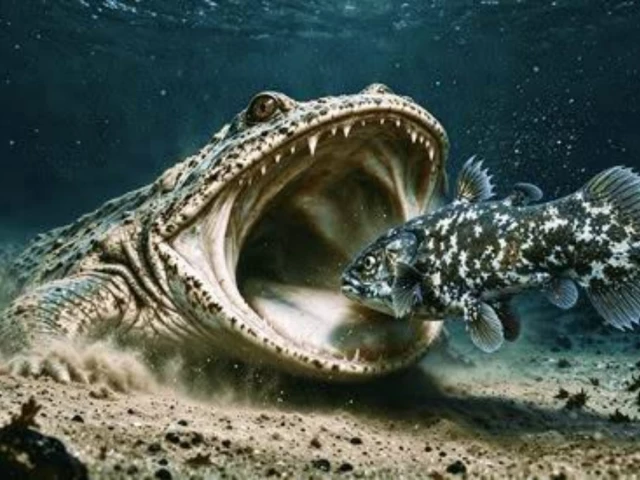
“A group of international researchers has reported the first fully marine species of stem amphibian, Gerrothorax maritimus, in a recent research article published in the journal Nature Ecology & Evolut…”
Based on two nearly complete skeletons measuring at least 737 millimeters from the Late Triassic (about 237 million years ago) discovered in southwest China's Guizhou Province, the researchers reconstructed the appearance of Gerrothorax maritimus: a flattened body covered with heavy bony armor, a broad and flat head, a wide mouth, and sturdy, well-developed gill arches, Science Daily.
More than 8,000 amphibian species exist today, but none of them lives entirely in the sea. Amphibian skin is permeable, which aids respiration but causes water loss in seawater, where high salinity adds physiological challenges.
Some living amphibians can tolerate brackish habitats where freshwater meets seawater, and fossils of ancient species have been found in coastal sediments. But previous evidence was insufficient to confirm that any amphibian ever had a fully marine lifestyle.
"Stay connected with Aman-e-Pakistan for ongoing live reporting and verified investigative updates."
Read More:Strange beaked 'hell chicken' is the first fruit-eating dinosaur. Gerrothorax maritimus is therefore recognized as the first stem amphibian known to date to have lived entirely in a marine environment, said Jiang Dayong, the article's corresponding author.
The researchers suggested that Gerrothorax maritimus's flattened body suited life on the seafloor, allowing it to hide in sediments. The species' heavy bony armor helped prevent water loss through the skin, while adults retained their gills and could breathe underwater, possibly without needing to surface to breathe air with their lungs.
The researchers of this study come from the Geological Museum of Guizhou, Peking University, and the University of California, Davis.
Written by Sheheryar Munawar
Aman-e-Pakistan Senior Journalist & Bureau Reporter
Continue Reading: More in International
Swipe or click arrows to explore International desk coverage
 International
Iranian negotiators in Doha to continue talks to end the US-Iran war, official says
 International
Strike at industrial complex in Saudi Arabia's Dammam causes huge fire: Iranian state media
 International