The era of new alliances
“Back to Tribune. HomeT-Magazine. The era of new alliancesT-Magazine. Next Story. The era of new alliances. The SCO offers a glimpse of an emerging international system that Washington is helping shape but may n…”
Back to Tribune. HomeT-Magazine. The era of new alliancesT-Magazine. Next Story. The era of new alliances. The SCO offers a glimpse of an emerging international system that Washington is helping shape but may no longer lead. ByHAMMAD SARFRAZ|facebooktwitterwhatsuplinkdedemailPUBLISHED
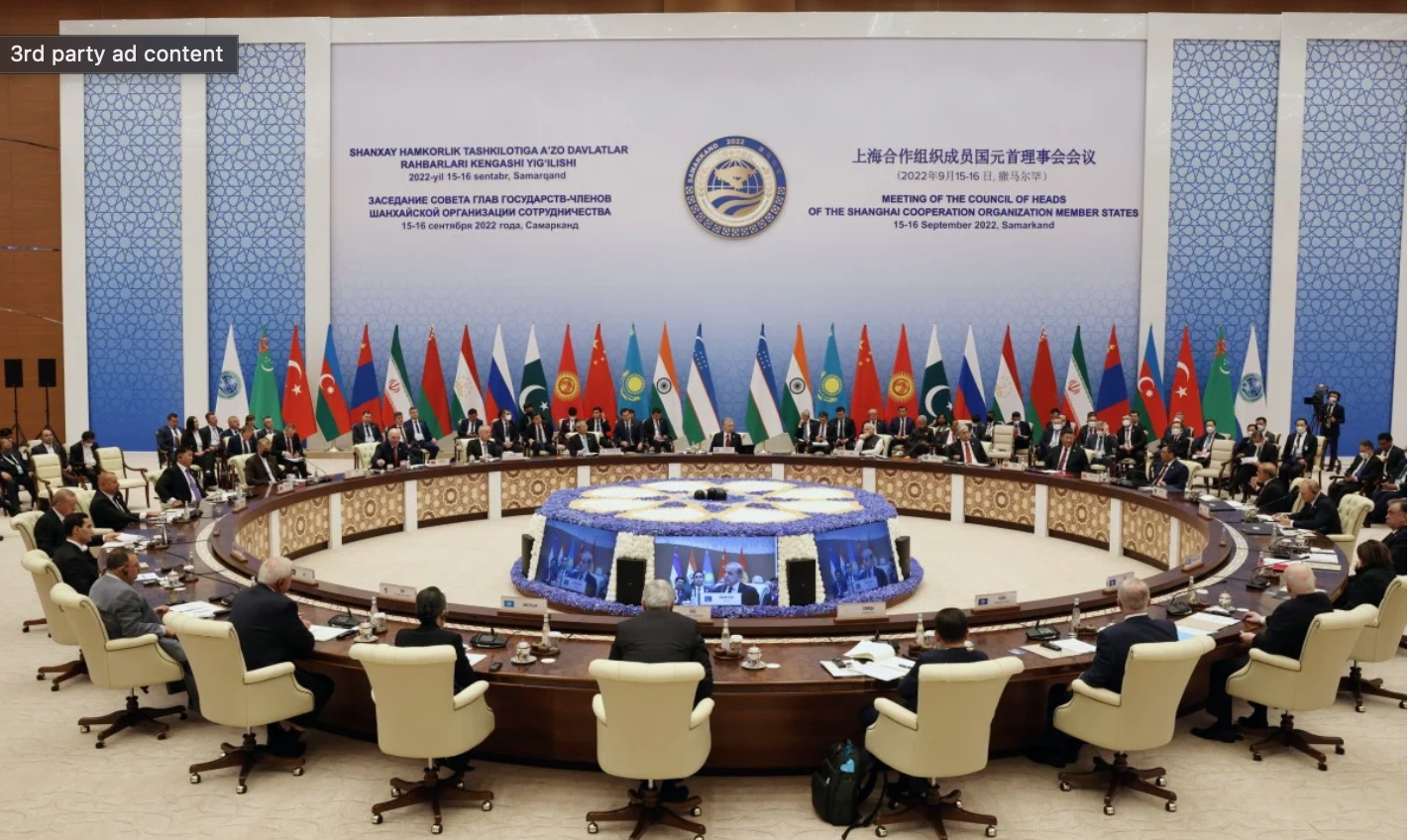
September 07, 2026The most revealing development at this year’s Shanghai Cooperation Organisation summit was not another declaration about the need for a multipolar world, it was Tayyip Erdogan’s suggestion that Turkey could seek full membership of an organisation whose two dominant powers are China and Russia.
Turkey remains a member of Nato and Erdogan was careful to say that closer ties with the Shanghai Cooperation Organisation (SCO) would not mean abandoning the West. But that is precisely what makes his statement so significant.
"Stay connected with Aman-e-Pakistan for ongoing live reporting and verified investigative updates."
A Nato member no longer sees participation in an institution led by Beijing and Moscow as something that requires an either-or choice. That would have been difficult to imagine when the post-Cold War order was at its peak.
Washington’s alliances were not simply military arrangements, they helped shape the balance of power and the way countries dealt with one another.
They could disagree with the US, trade with its competitors and pursue their own interests, but the basic understanding remained that the principal architecture of global security, finance and diplomacy would be shaped in Washington and its allied capitals across the West.
That assumption has started to fade, not because countries have suddenly decided to join a bloc created by China, but because fewer of them see any reason to organise their foreign policies around a single centre of power that is the US.Ashok Swain, professor of Peace and Conflict at Uppsala University, views Trump’s “America First” policies as accelerating this shift.
He argues that attacks on alliances, hostility toward multilateral institutions, unpredictable tariffs and the transactional treatment of even close partners have made the US look increasingly unreliable. Countries that once depended on Washington, he said, are therefore looking for other relationships and institutions.
Russia benefits from the divisions within Europe and Nato, while China, he argues, stands to gain even more by presenting itself as a stable economic and diplomatic partner as the US relinquishes influence.
“Trump may believe he is making America stronger,” Swain said, “but he is accelerating the decline of US global leadership and making the emergence of a China-led order easier.”The SCO summit in Bishkek offered a snapshot of what is emerging.
The organisation now brings together China, Russia, India, Pakistan, Iran and the Central Asian republics, as well as Belarus, and its wider network includes countries that have very different relationships with Washington. It is not a military alliance and its members have serious disputes with one another.
India and China remain at odds, India and Pakistan have a perennially antagonistic relationship, and Russia and China are partners without being formal allies. But all of them have found value in belonging to the same institution without having to resolve those differences or adopt the same relationship with the West.
At the summit in Kyrgyzstan’s capital, President Xi Jinping carefully calibrated his speech to preserve that flexibility, describing the SCO’s experience as one based on non-alignment, non-confrontation and a refusal to target any third party, even as he argued that the organisation should play a more active role in shaping international affairs.
He called multipolarity an irreversible trend and urged greater representation for the Global South, a more democratic international system and a stronger role for the United Nations. The language, by the Chinese leader’s standards, was familiar.
The substance, however, is becoming increasingly practical. Beijing wants the countries gathered around the SCO to have more trade, investment, transport, energy, technology and financial links with one another, creating a strong network of relationships that does not depend on any one Western institution or country.
Swain argues that the SCO has considerable potential precisely because it brings together China, Russia, India, Pakistan, Iran, Belarus and the Central Asian states. “It provides a platform for security cooperation, trade, energy, connectivity and resistance to Western political pressure.”
In that sense, he sees the organisation as developing a parallel system of cooperation, although not yet an alternative global order. “The SCO is not a military alliance,” he explained, and its members have “serious internal contradictions”, from the rivalry between India and Pakistan to India’s distrust of China and the differing interests and ambitions of its members.
Those contradictions could make enlargement both a source of strength and a constraint, making the organisation more representative while making consensus harder. But Swain believes the balance of power within the SCO will matter increasingly.
Over time, he argues, it is likely to become more China-centric because Beijing has the greatest economic and political weight. Russia will remain important, but its position could gradually come to resemble that of Europe in the former US-led order, an influential but unequal partner operating under the shadow of the dominant power.
For its part, it appears, Beijing is already putting resources behind its wider ambitions. President Xi announced plans for an international AI application cooperation centre for SCO members, a China-SCO port economic cooperation centre in Tianjin and 100 technological cooperation projects over the next three years.
He presented the organisation as a priority platform for high-quality Belt and Road cooperation and called for deeper collaboration in the digital economy, green industries, energy and resources. These initiatives may sound bureaucratic compared with declarations about a new world order, but institutions, experts argue, are built through precisely such arrangements.
Putin’s parallel proposal. In Bishkek, Vladimir Putin took the financial argument further, describing the SCO as an independent and influential centre of the emerging multipolar world. Russia’s trade with SCO members, he said, had exceeded $400 billion in the previous year, while national currencies accounted for more than 98% of Russia’s transactions with them.
He also backed the creation of an SCO development bank, arguing that it should be independent of financial systems belonging to states that use economic instruments as political weapons. For Russia, given its financial troubles, the push makes sense.
Western sanctions have made access to the dollar-based financial system a challenge, and Moscow has spent years looking for ways to bypass it. But the same parallel financial arrangements, experts believe, can serve many countries that have no intention of confronting the West or the US.
China,, appears to be in a far stronger position than Russia to provide that financial system. Moscow has energy, military presence, natural resources and diplomatic reach, but its economic base is weak.
China, on the other hand, has manufacturing capacity, capital, technology, a huge domestic market and an extensive network of commercial relationships across Asia, the Middle East, Africa and Europe.
It produces much of the world’s solar equipment, dominates important parts of the EV and battery supply chains and has spent years financing projects and industrial zones through the Belt and Road Initiative.
The SCO therefore gives Beijing something more useful than an anti-American alliance would, it provides a political space in which countries can increase cooperation without signing up to a common ideological programme or accepting China’s leadership as a condition of participation. On the other hand, the SCO cannot simply translate its impressive population and economic statistics into collective power.
The body may be growing, but growth cannot be confused with long-term cohesion. That said, cohesion is not necessarily what Beijing needs at this point. The SCO operates offers a structure of cooperation among countries that do not share the same interests on every issue, allowing them to build ties in particular areas without resolving their larger disagreements.
That model, experts argue, fits the foreign policy of many middle powers better than the old demand to choose sides. And Turkey is perhaps the clearest example.
Erdogan’s government wants to retain Nato membership and its relationship with Europe and the United States, while maintaining close economic and energy ties with Russia and expanding its connections across Central Asia and with China.
Ankara,, has no obvious interest in exchanging one dependency for another, its ambition is to make sure that it has enough relationships to avoid being dependent on any single power. Writing off Washington. Washington’s own policies have contributed to a shift that is leading nations, if not to abandon its orbit, then to move further away from it.
In that environment, the SCO offers an increasingly useful option. The Trump administration’s 2026 National Defense Strategy places the defence of the US homeland first, calls for stronger deterrence of China in the Indo-Pacific and asks allies to assume greater responsibility for their own security.
For Europe, a staunch US ally, the document shows a very scaled back US involvement in keeping the continent safe. The problem is that allies do not respond only to what Washington intends, they also respond to what they believe Washington might do next.
And under Trump, at least for now, no one really knows what is coming next. If American commitments appear more conditional or transactional, governments have a reason to look for alternatives before they need them.
That does not necessarily mean buying fewer American weapons or completely ending decades of security cooperation with the US. It can mean joining another organisation, signing another trade agreement, developing another payment system, cultivating another source of investment or building another diplomatic relationship and, in short, making the US-led architecture less of a necessity in the broader scheme.
Experts argue that American power has benefited for decades from a network effect. The more countries that used US-led institutions, the more valuable and influential those institutions became. China is trying to build a similar web of relationships, but it does not need to create a Chinese version of every American institution.
Instead, it can link the organisations and arrangements that are already taking shape around it.
The SCO provides a platform for that political and security cooperation, the Belt and Road Initiative connects infrastructure and trade, BRICS offers a forum for economic coordination, bilateral currency arrangements can facilitate payments outside the dollar, and Chinese technology and industrial capacity can support alternative supply chains.
None of these mechanisms, experts argue, need to replace the Western system on their own to weaken its dominance. Together, however, they give governments around the world more ways to operate outside the traditional Western system.
Bishkek showed how those alternatives can extend beyond economics, creating space for political alignment as well. Iran, a US adversary, for example, had a seat at the table, and SCO members voiced concerns over the actions against it, including India, which had previously been more restrained in its response.
That political alignment was also evident in how the leaders spoke about the international system itself. President Xi focused on global governance, the Global South and the need for a more representative international system.
Uzbekistan’s President, Shavkat Mirziyoyev, went further, arguing that the wider SCO could contribute to a new global governance architecture while retaining the United Nations as the central coordinating institution.
The rhetoric, experts argue, is meant to appeal to countries that have long complained that institutions created after the Second World War no longer reflect the distribution of economic and political power. All that said, none of this means that the US is about to disappear from the centre of global affairs.
Washington can still, if not shape the future of global alliances, at least influence what they look like in the near term.
It may be weaker and somewhat isolated, but it still has an extensive alliance network, considerable influence over the global financial system and other advantages that its main rival cannot easily replicate., a less predictable American commitment encourages hedging, which creates demand for alternative institutions. China, unlike any other potential rival, has the economic potential to help build them.
The contest ahead, experts argue, may therefore be less about which country convinces the world to join its camp than about which country becomes indispensable to the choices other countries make. China has spent years preparing for that competition, often through projects that appeared commercial rather than strategic at the time.
The result is a growing web of ports, railways, factories, energy links, digital infrastructure, financial arrangements and diplomatic forums in which Beijing is already present. The SCO, Swain argues, is an important part of that effort.
Its members, he explained, are not forming a Nato-style alliance but building flexible networks in which countries can cooperate on some issues while disagreeing on others. “Russia is using these relationships to escape Western isolation, China to expand its influence, while countries such as India and Turkey use them to hedge between competing centres of power,” the Sweden-based academic added.
“The world is no longer organized around one unquestioned center of power,” Swain noted. The US-led order, he said, is weakening while new and often flexible partnerships are emerging across Asia and the Global South.
The SCO’s Bishkek summit, Swain said, showed both the importance and the limitations of that shift. Multipolarity is emerging, but Swain sees it as “a transitional stage toward a more China-centered order” — a shift he believes is being accelerated by Trump’s erosion of American credibility and influence.
Pages. Pakistan. Business.
World. Opinion. Life & Style.
Sports. Blogs. Videos.
Our Sites. Express News. Urdu E-Paper.
English E-Paper. Sindhi E-Paper. Cricket Pakistan.
Express Live. Campus Guru. Express Entertainment.
Food Tribune. About Us. Contact Us.
Online Advertising. Privacy Policy. Copyright.
Fuel Prices Pakistan. Gold Prices Pakistan. Prayer Timing Pakistan.
Weather Forecast Pakistanfollow us
Continue Reading: More in International
Swipe or click arrows to explore International desk coverage