Inside the killing machine
“Back to Tribune. HomeT-Magazine. Inside the killing machineT-Magazine. Next Story. Inside the killing machine. In NAZA, the Isrealis who ran Gaza's killing machinery speak in their own words—and the state is tr…”
Back to Tribune. HomeT-Magazine. Inside the killing machineT-Magazine. Next Story. Inside the killing machine. In NAZA, the Isrealis who ran Gaza's killing machinery speak in their own words—and the state is trying to bury it. By. Our Correspondent|facebooktwitterwhatsuplinkdedemailPUBLISHED
November 22, 2026There is a word I have not been able to stop thinking about. NAZA. It sounds harmless.
Almost pleasant. It is, in fact, a piece of military shorthand, an acronym for the Hebrew term for collateral damage. In the Israeli military system it describes the number of civilians expected to die when a target is struck.
"Stay connected with Aman-e-Pakistan for ongoing live reporting and verified investigative updates."
Not people. Not children. An allowance, calculated in advance and signed off before a bomb is ever dropped.
A new documentary by Israeli filmmakers Yuval Abraham and Rachel Szor takes that word for its title, and for about 80 minutes it does something extraordinarily simple and extraordinarily rare. It lets the people who designed and operated the machinery of killing in Gaza describe that machinery in their own words.
You may know these names. Abraham and Szor are two of the four co-directors of No Other Land, which won the Academy Award for best documentary in 2024. That film showed the destruction of a Palestinian community in the occupied West Bank.
NAZA turns the camera around, onto their own society, and asks the question sitting underneath this entire war: how does the killing of civilians become ordinary, administrative work? The film premiered in competition at the Venice Film Festival in September, won the Special Jury Prize, and received a standing ovation reported at close to 25 minutes.
It has since sold to more than 50 countries and drawn more than 1.5 million viewers. And yet I would put money on the fact that plenty of people reading this have never heard of it.
Hold that thought, because we are coming back to it. The rooftop conversations. Here is how the film works.
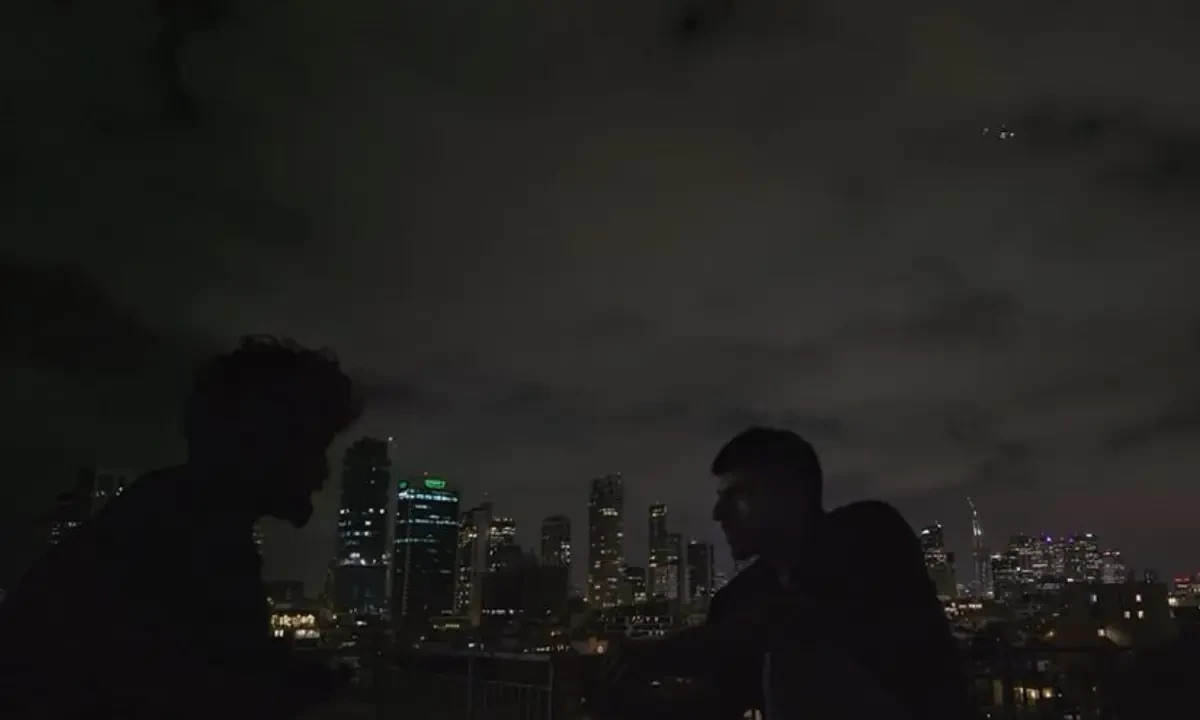
Over three years, Abraham and Szor interviewed more than 100 confidential sources. Twenty-four of them, Israeli intelligence officers and soldiers, appear on screen, filmed at night on rooftops in Tel Aviv with their faces and voices digitally altered.
Between the interviews, the camera drifts across to the windows of ordinary apartments. People watching television, doing yoga– 60 km from Gaza. I keep going back to those windows.
Two realities, sharing a night sky, one of them kept deliberately comfortable. Abraham has noted the irony that runs deeper than the image. Tel Aviv is regarded as Israel's liberal centre, and many of the intelligence officers who appear in the film belong to exactly that liberal, educated elite.
The distance between the apartments and the rooftops is not just geographic. It is the whole story of how ordinary people end up running extraordinary machines. And what do the voices describe?
The machinery itself. There is Lavender, an AI system that assigned nearly everyone in Gaza, with a phone, a score from 1 to 100 for how likely they were to be a Hamas or Islamic Jihad member, earmarking up to 70,000 phone numbers as potential targets, with an accepted error rate.
"Where's Daddy? " is the practice of using surveillance, including children's phones, to work out when a targeted operative was home, so strikes could hit family houses at night. One officer describes hacking a 12-year-old girl's phone and then killing her.
And there is the cold math. "We say 15 NAZA. We don't say 15 people killed, and certainly not that 15 children and women will be killed.
We say 15 NAZA." Twenty NAZA became the benchmark for lower-ranking targets. One interviewee was involved in a strike approved for up to 500 civilian deaths to reach a single person.
When Abraham presses one man on the "human shields" justification for all this, the answer is chilling in its honesty. He calls it "absurd". The real reason civilians die this way, he says, is that "it's just easier".
Another compares the work to a video game, "You feel a bit like God because you hear everything they say. " A third shrugs, saying that, "Gaza becomes like a factory of targets,.
" One of the officers describes an 80-year-old woman flagged by Lavender, her house bombed with her family inside, a mistake that troubled the intelligence community, he says, "on a professional level". Why perpetrator testimony matters.
More than 70,000 Palestinians have been killed in Gaza since the Hamas-led attack of October 7, 2023, an attack that killed around 1,200 people and took some 250 hostages. For more than two years we have been asked to navigate that reality through competing narratives.
Official denials. An inaccessible battlefield. Casualty figures governments urge us to doubt.
Testimony from victims, filtered and dismissed, when it surfaces at all. NAZA cuts through that fog because of who is speaking. Not the victims, whose words are so often treated as suspect.
Participants. Sometimes with shame, sometimes with pride. People describing systems they built and ran, corroborated by multiple sources for every major claim, in some cases more than a dozen.
Abraham calls it "shooting and not crying", a deliberate inversion of the Israeli genre of soldiers' confessions that seek absolution. The British Film Institute (BFI) reviewer described the experience of watching it as a war crimes truth commission quietly taking place on screen.
Truth telling does not get more primary source than this. The directors say they made the film "out of a sense of obligation to use our position as Israelis to examine the systems behind the mass killing of Palestinian civilians for which our country is responsible".
I have spent a lot of my working life thinking about whose testimony gets believed, and whose gets filtered, doubted or filed away. The answer usually depends on who is doing the telling, and how much power sits behind the version we would rather hear.
That is why this film matters beyond its subject. It removes the last available excuse, the claim that we simply did not know, and it does so in the voices of the people who did it.
So why didn't we know? Here is the part I can’t shake. Most of what NAZA reveals was already published.
In 2024. The Lavender and "Where's Daddy? " systems were exposed through investigative reporting by +972 Magazine, carried internationally by The Guardian, and the film grew directly out of that collaboration.
In many parts of the world, that reporting never became front page news. Casualty figures were relayed through official frames. The phrase "collateral damage" did its sanitising work, exactly as designed.
And the systematic nature of the targeting, the spreadsheets, the benchmarks, the signed allowances, was rarely – if ever – pieced together for the people expected to vote, protest, or simply care. Dead children trend as numbers, when they trend at all.
The machinery never trends. Meanwhile the people who made the film are paying for it. Israeli Prime Minister Benjamin Netanyahu has called for the 24 interviewees to be prosecuted, and Israel's culture minister has demanded the directors be stripped of their citizenship for "treason".
A change in leadership is unlikely to stop this. Protesters have stood outside Szor's parents' home with "traitors" banners. Both directors have received death threats and cannot safely return home.
No Israeli cinema will screen the film, and the government has even promoted a mimic film, Naza: The Real Story, copying the rooftop setting to confuse audiences. When a state goes to that much trouble to bury a film, the film is telling us something the state does not want known.
The backlash is the measure. Watch it anyway. The filmmakers have chosen reach over revenue.
After its cinema run, NAZA is being released in full, for free, on The Guardian's website this month. I invite you to watch it. Not because it is easy.
It is not. But because somewhere behind every "15 NAZA" there were fifteen human beings who did not get to be anything but a number, and the very least we owe them is to look at how that happened.
Near the end of the film, one of the interviewees tries to hold two ideas at once. He still sees the Nazis as absolute evil, he says, but now he understands how a man can blow up a place and go home to get his degree in clinical psychology.
"What does that mean I am? " he asks. That question is not only his.
It belongs to everyone who looks away. Truth telling included. The writer is an Australia-based independent disability advocate, working at the intersection of disability and gender in climate, disaster risk reduction and women peace and security.
All facts and information are the sole responsibility of the writer. Pages. Pakistan.
Business. World. Opinion.
Life & Style. Sports. Blogs.
Videos. Our Sites. Express News.
Urdu E-Paper. English E-Paper. Sindhi E-Paper.
Cricket Pakistan. Express Live. Campus Guru.
Express Entertainment. Food Tribune. About Us.
Contact Us. Online Advertising. Privacy Policy.
Copyright. Fuel Prices Pakistan. Gold Prices Pakistan.
Prayer Timing Pakistan. Weather Forecast Pakistanfollow us
Continue Reading: More in International
Swipe or click arrows to explore International desk coverage