German and US scientists win Nobel medicine prize for work on optogenetics
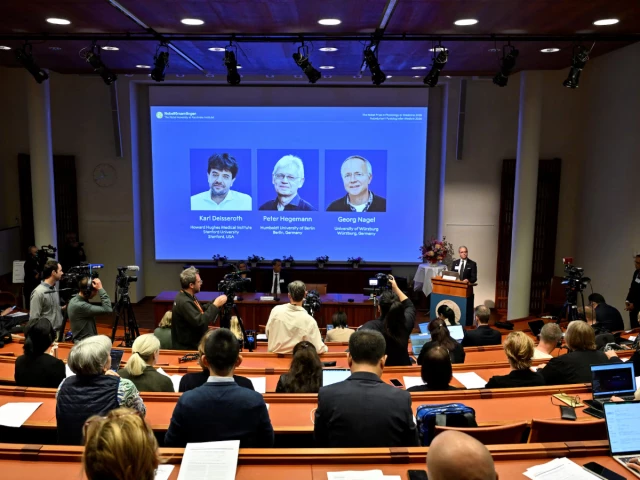
“American Karl Deisseroth and Germans Peter Hegemann and Georg Nagel won the 2026 Nobel Prize in Physiology or Medicine on Monday for their discoveries on light and optogenetics that have helped unde…”
The Nobel Assembly at Sweden's Karolinska Institute medical university said Deisseroth, 54, Hegemann, 71, and Nagel, 73, were selected for their "discoveries concerning light-gated ion channels and optogenetics. "BREAKING NEWSThe 2026#Nobel. Prizein Physiology or Medicine has been awarded to Karl Deisseroth, Peter Hegemann and Georg Nagel “for their discoveries concerning light-gated ion channels and optogenetics.”pic.twitter.com/pkDDEBWtkz— The Nobel Prize (@Nobel.
Prize)October 5, 2026Optogenetics "makes it possible to switch on, or off, the activity of individual nerve cells in a living brain," said Thomas Perlmann, Secretary-General of the Nobel Assembly at Karolinska Institutet. "This method is now being used in laboratories around the world to reveal the brain’s mysteries," Perlmann said.
In clinical trials, researchers are restoring vision to people blinded by a condition called retinitis pigmentosa by inserting a light-sensitive protein in the retina. Researchers also hope optogenetics could improve cochlear implants, allowing more precise stimulation of the auditory nerve than current electrical devices.
"Stay connected with Aman-e-Pakistan for ongoing live reporting and verified investigative updates."
The Physiology or Medicine Prize traditionally opens the annual Nobel announcements, with awards in physics, chemistry, literature, peace and economics to follow over the coming days.
Deisseroth, Hegemann and Nagel will share a prize sum amounting to 12 million Swedish crowns ($1.2 m).🏅 The Nobel medicine prize was awarded Monday to US psychiatrist and neurologist Karl Deisseroth and his German colleagues Peter Hegemann and Georg Nagel for their work in the field of optogenetics.➡️https://t.co/706OtUItETpic.twitter.com/Ttk. NaMPeaW— AFP News Agency (@AFP)October 5, 2026Recipients surprised and delighted.
In the early 1990s, Hegemann investigated how the alga Chlamydomonas reacts to light in half a millisecond. He hypothesised that a single protein captured light and acted as an ion channel. Nagel tested this by injecting Chlamydomonas genes into frog eggs, discovering channelrhodopsin-2—an ion channel that opens when exposed to light.
In 2003, they published that this protein could be introduced into human and hamster cells to generate electrical impulses using light. In 2005, Deisseroth at Stanford demonstrated the technique in rat nerve cells, and the method was named optogenetics a year later.
Perlmann said he had talked to all three laureates this morning, and that they were surprised and delighted. "All three said the same thing, that they thought it was absolutely wonderful to receive the prize with the other two, and they call them my friends.
That it's such an honour to receive them together. So that's something they conveyed," Perlmann said. Nobel prizes awarded since 1901The five original Nobel Prizes were created under the terms of Swedish inventor and industrialist Alfred Nobel's will and have been awarded since 1901, with only limited interruptions, chiefly during World War One and World War Two.
A sixth award, the economics prize, was established in 1968 by Sweden's central bank, the Riksbank. The medicine prize has honoured some of the most influential scientific discoveries of the past century, including Alexander Fleming's work on penicillin, recognised in 1945, and Karl Landsteiner, who won in 1930 for his discovery of human blood groups.
Continue Reading: More in International
Swipe or click arrows to explore International desk coverage
 International
Instagram turns 16 with 3 billion users under shadow of data privacy, mental health concerns


 International