Rare shelf cloud formation captivates residents along New Jersey coastline
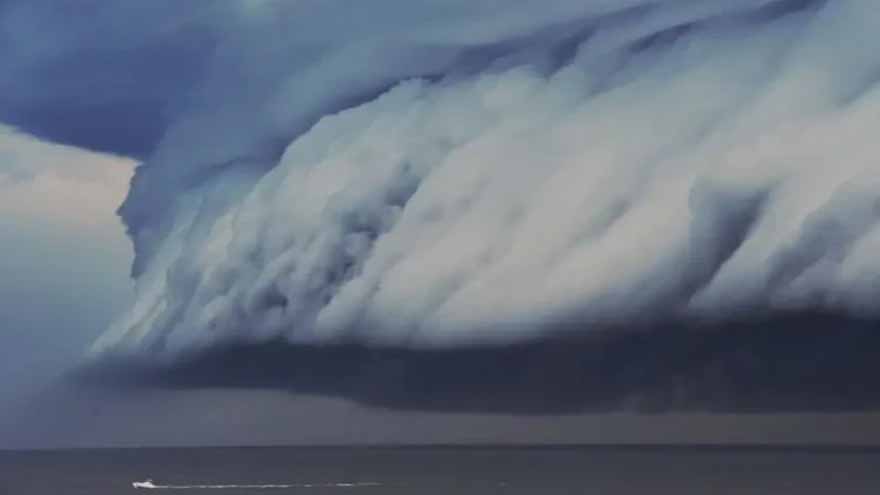
“A dramatic and rare meteorological event occurred over the coastal region of Cape May in the United States state of New Jersey, where a massive, wave-like cloud formation swept across the horizon, dra…”
The phenomenon, which appeared as a dark, elongated band stretching across the sky, created a striking visual illusion of a colossal ocean wave cresting above the sea. As the formation advanced toward the shoreline, it prompted widespread discussion and awe among those who witnessed the event firsthand and through digital platforms.
The spectacle was captured in video footage that quickly gained traction on social media, showcasing the sheer scale and intensity of the cloud structure as it moved steadily over the coastal landscape. While the visual impact of the formation led to initial speculation regarding its nature, weather experts were quick to clarify the scientific classification of the event.
Meteorologists confirmed that the formation was not a tornado, but rather a classic example of a shelf cloud. A shelf cloud is defined as a low-altitude, horizontally structured, or wedge-shaped cloud formation that typically develops along the leading edge of a thunderstorm or a robust wind system.
"Stay connected with Aman-e-Pakistan for ongoing live reporting and verified investigative updates."
These formations occur when cool, sinking air from a storm system pushes warmer, moist air upward, causing it to condense and form the characteristic shelf-like appearance.
The dramatic aesthetic of a shelf cloud is often enhanced by the contrast between the dark, dense base of the cloud and the surrounding sky, which can create an intimidating yet fascinating sight for those on the ground.
Experts noted that such clouds are common precursors to significant weather changes, often signaling the arrival of gusty winds, heavy rain, or a sudden drop in temperature as the associated storm system moves through an area.
Despite their imposing appearance, which can sometimes be mistaken for more severe weather phenomena like tornadoes or funnel clouds, shelf clouds are distinct in their structure and movement. They are primarily associated with the outflow of a storm rather than the rotation that characterizes tornadic activity.
The incident in Cape May serves as a reminder of the complex and often visually stunning nature of atmospheric processes. The event highlights how localized weather patterns can produce rare and captivating displays that briefly transform the familiar coastal horizon into a scene of natural wonder.
As the shelf cloud traversed the New Jersey coast, it provided a clear demonstration of the power and beauty inherent in meteorological systems, leaving a lasting impression on the community. The widespread sharing of the footage underscores the public's enduring fascination with extreme weather events, particularly those that offer such a unique and dramatic perspective on the environment.
While the cloud formation eventually dissipated as the weather system moved inland, the images and videos captured during the event continue to serve as a reference for the visual characteristics of shelf clouds.
Weather authorities often use such occurrences to educate the public on the differences between various cloud types, helping to distinguish between benign, albeit dramatic, formations and those that may pose a genuine threat to public safety.
By providing context on the formation, experts aim to ensure that future sightings of similar phenomena are met with informed observation rather than unnecessary alarm, allowing the public to appreciate the intricate mechanics of the atmosphere while remaining aware of the potential for associated weather shifts.
This event remains a notable example of how natural phenomena can capture the collective imagination, turning a standard weather occurrence into a shared experience for thousands of viewers across the globe.
Written by Hania Amir
Aman-e-Pakistan Senior Journalist & Bureau Reporter
Continue Reading: More in International
Swipe or click arrows to explore International desk coverage