As Trump basks in summit pomp, China's Xi strengthens his hand
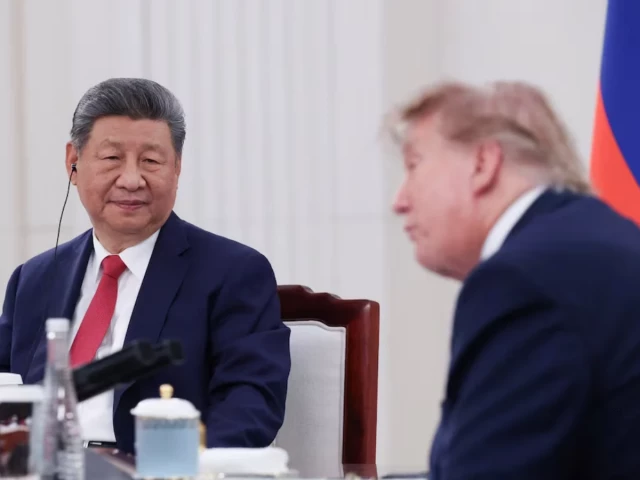
“US President Donald Trump hailed the fanfare of his meeting this week with Xi Jinping as a victory, but the US president has gained little from three such summits this year while the Chinese leader h…”
Xi emerged from a global gathering in China as a statesman who could convene the first China-US-Russia summit and he keeps a fragile trade truce with the US in a holding pattern — where Beijing likes it — even as Washington takes a harder line. At least in terms of public announcements, Trump has few concrete gains to show.
"They have achieved the Chinese Communist Party's and Xi's goal, which was to keep dragging things out and keep talking," said Kuo Yu-jen, director of Taiwan's National Sun Yat-sen University's Institute of China and Asia-Pacific Studies. Trump-Xi summits give China 'strategic space'Xi broke with protocol to greet Trump at Shenzhen airport ahead of Thursday's Asia-Pacific Economic Cooperation summit.
Trump called the gesture "a big win" even before his meetings began, similar to how he has described the pomp of previous meetings. Xi orchestrated moments befitting a visiting president focused on legacy-building: the pair shared a hug at the airport and held the first-ever trilateral meeting with Russia's Vladimir Putin.
"Stay connected with Aman-e-Pakistan for ongoing live reporting and verified investigative updates."
On substance, Xi was less generous. Read:Big powers summit yields peace vows but few specifics. Trump his Chinese counterpart had spoken about AI, trade and oil flows through the Strait of Hormuz.
The US demands Beijing buy more US farm goods, ease curbs on rare-earth minerals vital to key industries and release two Americans who Washington says are wrongfully detained. China's Foreign Ministry said the two sides agreed to map out an action plan for building a "constructive relationship of strategic stability" — a framework already unveiled in May.
The ministry gave no details or timeline. Beijing's readout did not mention the fragile US-China trade truce, China's agricultural commitments, rare earths, chip controls, the scandal over US chip giant Nvidia or the detained Americans, and did not name Iran.
China is on track to meet its soybean pledge for 2026 but has delivered only a fraction of the other promised farm purchases, while rare-earth shipments remain far below the levels before the trade war escalated last year, and neither detained American has been freed.
Xi also pushed his key demand that the US "keep doing the right thing" on Taiwan or risk setbacks in the bilateral relationship,. China views democratically governed Taiwan as its own territory, a claim Taipei rejects.
"China has secured additional strategic space, including the US stance on the Taiwan issue and the easing of the technology embargo. Strategically, the US has indeed gained nothing," said Dan Wang, China director at the Eurasia Group think tank.
Trump's agenda focused heavily on the meeting with Xi and Putin, which released a joint "Declaration Toward Peace" that analysts described as vague. Hosting the trilateral summit, which Trump had pushed for, offered Xi a platform to cast himself as a central player in managing global affairs, analysts said.
China bides its time as US gets tougher on chips.
Since this month'sresignation of Jensen Huang, a Trump ally, as Nvidia's CEO over the revelation that he had had an affair with a woman who US intelligence believes is a Chinese spy, the Trump administration has sought to close loopholes that let Chinese companies bypass US restrictions on AI chip exports.
On the day Trump and Xi met, a US rulefurther restricting. China's access to advanced AI chips from companies such as Nvidia took effect. The US administration is also weighing a rule requiring US companies to disclose their use of Chinese AI models.
US lawmakers have also been moving against China. Beijing, which seeks to encourage Trump to stabilise bilateral relations while defending Chinese industries, has vowed retaliation against such curbs and is in no hurry to meet US demands, analysts say.
"The Chinese see these noises as a natural part of the relationship," said Shen Weizhong, a former Chinese Foreign Ministry official who now works for Beijing-based think tank Global Governance Institution. Read more:China and Russia release 'peace declaration' after Trump, Xi, Putin meeting"The Chinese have learned their lesson: they won't fulfil their side of a promise all at once.
They'll do it step by step," he said. Holding back concessions gives Beijing leverage if Washington adopts a tougher stance, as pressure builds in Congress from lawmakers in both parties.
This week, a House of Representatives committee report called for restricting investment in China's aerospace sector and a senator introduced legislation to revoke China's normal trade status and favourable tariff treatment.
An extension of the trade truce is expected to wait until a meeting of Group of 20 leaders in Miami next month, when Xi and Trump are expected to meet again. The truce, struck at a meeting in South Korea last year and extended during Xi's visit to Washington in September, expires on January 10.
The "low-hanging fruit " has been harvested after extensive trade talks over the past year, said Even Rogers Pay, director at Beijing-based consultancy Trivium China. "It may feel like a holding pattern by comparison to past summits, but in the current context it's actually a significant step, given the recent midterm elections and the Jensen Huang scandal.
"Analysts expect the year's fourth Trump-Xi meeting will also be heavy on optics. "But substantially, I don't think there's going to be very big progress. It's going to be about stability and stability," said Shen, the Chinese former official.
"And that's enough. "
Continue Reading: More in International
Swipe or click arrows to explore International desk coverage