UOL conference decodes strategic shift of Makkah Joint Defence Agreement
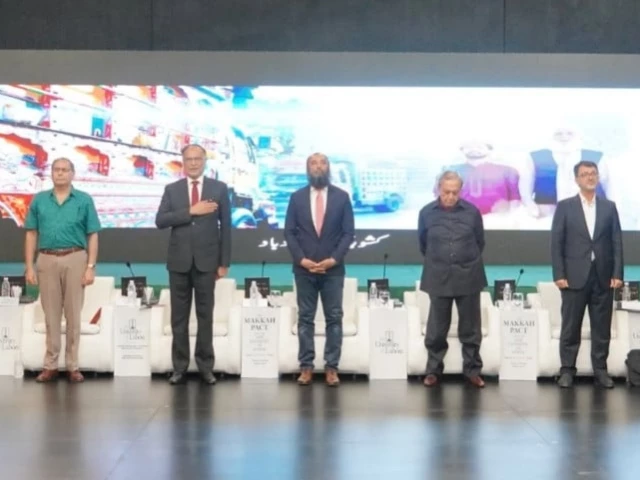
“The University of Lahore (UOL) on Thursday hostedan internationalconferenceto examine the strategic implications of the newly formed“Makkah Joint Defence. Alliance”. A press release issued by UOL said th…”
A press release issued by UOL said the event convened "top political, diplomatic, military, academic, and media leaders" to assess the "evolving security dynamics" of the Middle East and South Asia, further adding that the conference focused on how the tri-nation agreement would impact regional peace, stability, and economic cooperation amid rapid geopolitical shifts.
The UOL press release noted that Chairman, Board of Governors, UOLAwais Raoof opened the discussion and maintained that the "erosion of the global order" and of human rights in recent years had made the emergence of the Makkah pact a welcome development for the region, adding that universities such as UOL had a responsibility to provide a platform for such dialogue.
It added that Raoof described the agreement as "defensive in nature" but potentially the beginning of a new "regional security structure", noting that several other countries had expressed interest in joining it., Minister for Planning Ahsan Iqbal, in his inaugural address, said the most consequential contests of the 21st century would be decided not by "military power alone but also in universities, laboratories, technology centres, financial markets and factories".
"Stay connected with Aman-e-Pakistan for ongoing live reporting and verified investigative updates."
UOL said that Iqbal highlighted that the international order was passing through an interregnum between a receding unipolar moment and a multipolar order yet to fully take shape, noting that the Makkah Joint Defence Agreement, signed on 7 August 2026 in.
Makkah al-Mukarramahby Prime Minister Shahbaz Sharif, Crown Prince Muhammad bin Salman and President Recep Tayyip Erdogan, reflected this changing geometry of power and was an arrangement for collective deterrence rather than aggression.
The press release added that Punjab Assembly Speaker Malik Muhammad Ahmad Khan, who was also the chief guest, stated during the second session that the pact "should deliver peace to the region through deterrence, describing it as a message of strength and unity among Pakistan, Saudi Arabia and Turkiye.
"It added that Khan also appreciated UOL for its continued efforts in organising "impactful" academic activities, recalling the earlier governance conference as a notable example of the university’s commitment to meaningful dialogue and institutional development., former foreign minister Khurshid Mahmud Kasuri, in his keynote address, observed that the Makkah pact reflected the sentiments of the wider Muslim world and the ordinary people of Cairo, Jeddah, Lahore, Karachi, Ankara and Istanbul, describing it as an "arrangement of deterrence" for the integrity and sovereignty of Pakistan, KSAand Turkiye.
It added that former national security adviser Lt Gen (retd) Nasir Khan Janjua expressed that the global balance of power was shifting, with the rising influence of Russia, China and the Muslim world set against a relative decline of the United States, and called for greater regional unity as the basis of stability.
The press release said former foreign secretary Jalil Abbas Jilani shared that the pact reflected the diplomatic achievements made under the leadership of PM Shehbaz and Chief of the Army Staff and Chief of the Defence Forces (CDF) Field Marshal Syed Asim Munir, and that it should be understood in the context of the evolving strategic environment in the Middle East, It added that during the first roundtable, “Middle Powers and the Making of a New Regional Security Architecture”, participants shared perspectives on Pakistan’s position as what commentators have described as a “prisoner of geography,” bordered by historically adversarial relations with India and Afghanistan, and on the Makkah accord as offering Pakistan a route toward greater engagement with the Middle East; the evolution of global power blocs since the end of the Cold War and the collapse of the bipolar order that followed; and the potential for the agreement’s collective defence, political coordination and military-technological cooperation mechanisms to form the foundation of a wider regional security architecture for the Muslim world.
The press release said thatthe second roundtable, “Geo-Strategic and Economic Dividends”, examined the agreement’s potential to expand Pakistan’s strategic engagement beyond traditional regional constraints, strengthen economic and technological cooperation among Pakistan, Türkiye and Saudi Arabia, create opportunities for investment, connectivity and joint defence production, and translate the three countries’ complementary economic, technological, human and strategic capabilities into a broader regional framework for security and development.
Continue Reading: More in International
Swipe or click arrows to explore International desk coverage