Climate Policy misses mental health | The Express Tribune
“Back to Tribune. HomeT-Magazine. Climate policy misses mental healthT-Magazine. Next Story. Climate policy misses mental healthA new paper argues that environmental treaties must not ignore the toll on human …”
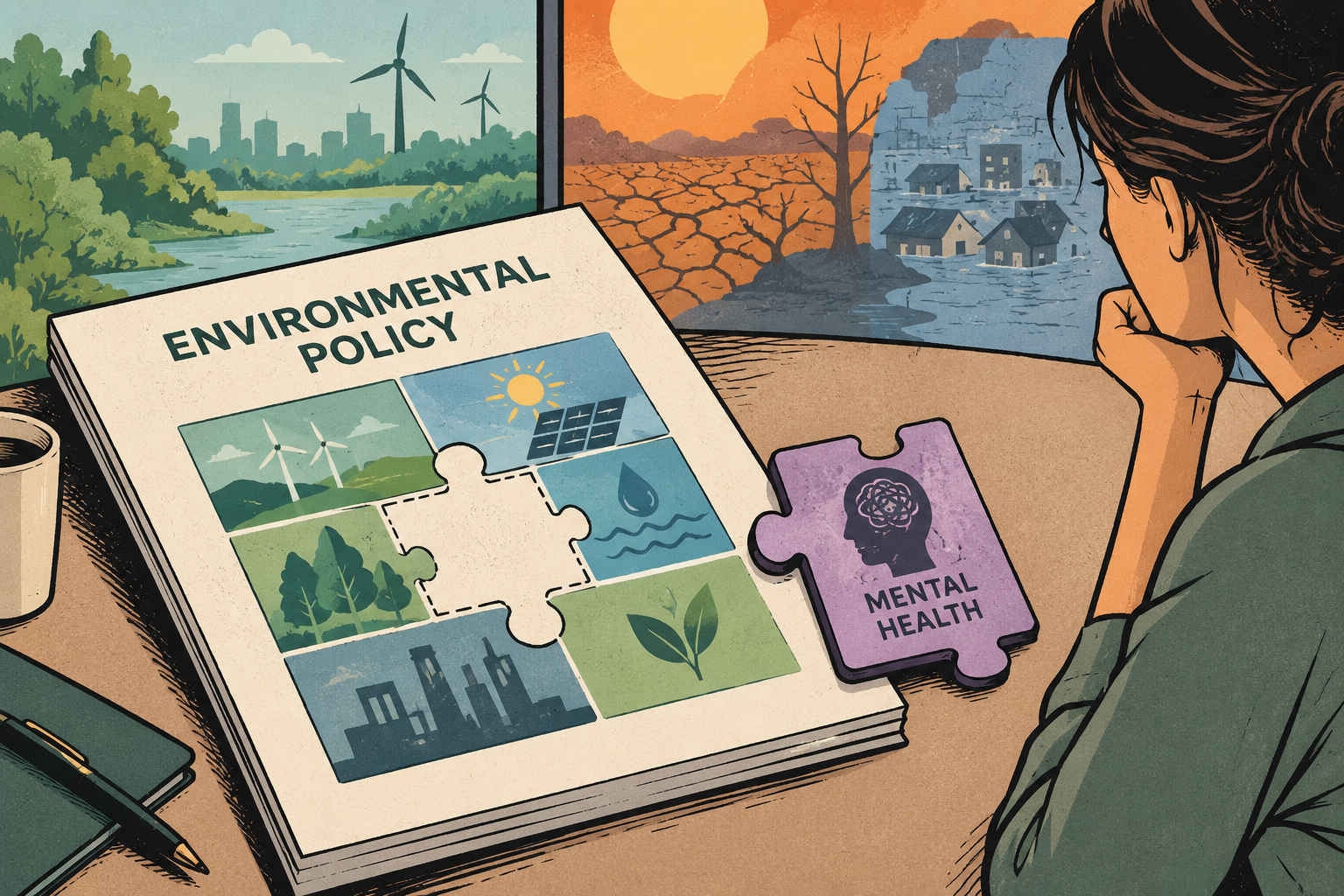
Back to Tribune. HomeT-Magazine. Climate policy misses mental healthT-Magazine. Next Story. Climate policy misses mental healthA new paper argues that environmental treaties must not ignore the toll on human minds. ByHAMMAD SARFRAZ|Photo: AI GeneratedfacebooktwitterwhatsuplinkdedemailPUBLISHED
September 13, 2026What happens to a person when their land is washed by water or parched by drought? The climate crisis is often measured in degrees and metres, but for millions of people, it is much harder to measure.
Governments spend decades building environmental policy around science and economics, but they continue to ignore the toll on human minds.
"Stay connected with Aman-e-Pakistan for ongoing live reporting and verified investigative updates."
From floods, droughts, extreme heat, displacement, to lost livelihoods, these aren’t just physical and financial disasters, they leave behind anxiety, depression, trauma and a kind of distress that can last for years, and for children the damage is even deeper, extending to disrupted schooling, fractured families and shattered social networks.
A recent paper in Nature makes the case that this has to change. The authors argue that mental health and psychosocial well-being should be woven into the fabric of environmental policy—into how we design climate adaptation, reduce disaster risk and assess loss and damage—not as an afterthought but as a core goal.
The paper, led by Manasi Kumar, a clinical psychologist and professor of population health at NYU Grossman School of Medicine, takes a hard look at the global treaties meant to protect our planet. Take the Paris Agreement, the Convention on Biological Diversity, the Stockholm Convention on toxic chemicals.
They were designed to regulate emissions, protect ecosystems and control hazardous substances, but they were never meant to measure human well-being, let alone ensure it, and the consequences of that omission are becoming impossible to ignore.
Research shows that the metals and pollutants that accumulate in our environment don’t just damage physical organs, they also erode mental health, and for communities tied to the land, watching species vanish and traditional ways of life unravel is its own kind of grief.
Children exposed early to neurotoxins like mercury and lead can suffer derailed brain development, setting the stage for mental health struggles later in life. The solution, the authors argue, is to treat environmental governance as what they call “upstream” mental health policy—stopping the damage before it starts.
Regulate pesticides, and you prevent suicides. Cut mercury emissions, and you protect developing brains. Build climate adaptation plans that include psychosocial support, and you prevent trauma from becoming chronic mental illness.
To make this work, the authors have proposed a tiered framework. The highest priority treaties are those that regulate chemicals and hazardous waste, because they have the most direct impact on mental health and the clearest measurable outcomes.
Restrict hazardous pesticides, and suicide rates drop. Ban persistent organic pollutants, and children’s brains develop more safely. One tier down are the climate and biodiversity treaties.
The links here are more indirect—disasters, food insecurity, displacement, loss of culture—but the scale of impact is enormous.
Then there are the ozone treaties, which matter for mental health but in longer-term, less direct ways, and finally a cross-cutting tier anchored in human rights: the conventions on children and people with disabilities, which offer an accountability framework for the most vulnerable. What makes the paper’s argument practical is that it doesn’t call for new data systems.
The information already exists, suicide rates, developmental outcomes, distress after disasters, food insecurity, displacement, and the UN tracks all of this. What needs our attention is the connection linking these indicators to treaty implementation and using them to measure success.
“Wholly new indicator systems are not required,” the authors write.
“We just need to strengthen what we have, disaggregate it properly and use it with intention.”Through this paper, Kumar and her colleagues are calling for a shift in how we think about environmental policy—not just as a technical exercise in emissions cuts and biodiversity protection, but as a fundamental tool for protecting mental health.
I sat down with Kumar earlier this month to discuss how this might actually work. We talked about convincing finance ministers that integrating mental health into environmental work is actually the most cost-effective move they could make, and how to measure the grief that comes when people lose not just their land but their culture and identity.
Toward the end of the interview, I gave her a challenge: thirty seconds with the World Health Organization (WHO) Director-General — what’s your pitch? Q: A finance minister looks at your paper and says: We already budget for health and environment separately.
Why are you asking us to double the work? What is your most compelling argument that tackling this jointly is the most cost-effective move? MK: There are two ways to answer it.
One is that for promotion of health—particularly mental health promotion, which is important to address the well-being of youth and vulnerable populations—it is much better, both programmatically and in terms of return on investment, to infuse those messages within a broad, ambitious environmental health policy and to focus on the co-benefits of a sustainable environment.
The second is from the perspective of management of mental health conditions. The number of individuals at risk and living with problems is staggeringly high, particularly in lower- and middle-income countries, many of which have large youth populations.
By addressing this in an integrated manner, we are trying to address the productivity loss that will occur when these young populations—as well as populations supporting informal work sectors, which are huge in parts of Africa and South Asia—lose quality of life and livelihood opportunities. It becomes a very big demographic when you look at the affected population.
So actioning both from the perspective of promotion and from disease management—mental health falls within Non-Communicable Diseases (NCDs)—addresses a very big pool of problems in the global burden of disease that every country is facing these days. Q: In Pakistan and similar countries, mental health isn’t taken seriously.
How do you convince society and politicians that this is worth acting on—especially when it's so common and ignoring it only makes things worse? MK: That is a really important point. Pakistan has been a leader in global mental health solutions—many interventions are well recognized.
There is recognition among experts that easily available solutions exist, but more importantly, the burden of mental disturbances is going up across the board and is disproportionately high in countries like Pakistan. Youth are badly affected, women are badly affected, and there is an element of stigma.
It is very important for political masters to take note of what these conditions do. A terminology that is helpful here is ‘productivity loss’ and the ‘cost of inaction.’
Not enabling the well-being of a young mother impacts the family, the children, the husband’s ability to care for the family—the family loses income, the woman suffers, the children suffer, the older parents suffer.
The recognition of the cost of inaction and the benefits of mental health—mental health in the short run costs a little bit, but the benefits are eight to ten times higher—is crucial.
If countries with this youth demographic want to get out of the poverty trap and rise from LMICs to middle-income countries, they have to enable resilience in their population. You can only do that by acknowledging that mental health matters.
Experts in Pakistan have tools to make an impact—they may lack resources or mandate, but they know what to do. Communities recognize this too. We have to work on stigma reduction and get the political class to buy into the idea that this will strengthen national identity as well as productivity and growth.
Stigma remains a persistent barrier, but I have fantastic examples from Pakistan that tell me it is very much possible—and Pakistan will lead. Q: The Rotterdam Convention link—cutting pesticides, cutting suicides—is a clear silver bullet.
Why have global health bodies dragged their feet on using these environmental metrics as official mental health indicators, despite the evidence? MK: This is a late realization between ministries of environment and health that they have to work in tandem.
More recently, with the depletion of overseas development assistance and the way global politics has changed, there is recognition that countries have been underinvesting in both sustainable environmental initiatives and human health. We’ve all been investing much more in missions to space or defense boosting, but have been underinvesting in the human beings who inhabit our planet.
So there is a long history of under-recognition, slumber, and lack of foresight about how partnership needs to be done proactively. The most immediate benefits of a sustainable environment will be on human health, but that recognition has been slow.
Mechanisms to actualize these also come in the way—we need frameworks that speak to one another. UN agencies, even though they operate for the greater good, have silos of their own, and member states have similar problems.
We need political initiatives and researchers to open their minds and start looking at a bigger logic framework.
As a mental health specialist and the team that did this paper, we were able to show that if you saw these patterns together, you’d immediately address vulnerable farming communities in LMICs, reduce harms that young people are going through in agrarian contexts, and help fishermen in different parts of the world.
It’s straightforward and easy to implement—that was the whole point of the Tier One approach. But we have to start seeing it holistically. Attitudinal change is very important to begin with.
Q: Does climate mental health need to be region-specific? Our struggles are closer to Bangladesh and India than to Texas. Shouldn't this be more about regional collaboration instead of leaving it to big global summits?
MK —We don’t have a choice—it has to be at all levels. We still rely a lot on donor funding, and national governments have not done enough. There is chronic underinvestment in well-being—corruption, mismanagement of existing resources, lack of foresight.
These are places that could do so brilliantly if not for these problems. You’re right that the action that will be most meaningfully operationalized will be locally led. But locals can only go so far—there has to be a national level that brings it together, pools evidence, and gives direction.
Regional cooperation is so important—look at India and Pakistan, who could do so much better if they collaborated, given how much they have in common and how similar their populations’ challenges are. Finally, a global mandate allows us to recognize the challenges we face as a species.
COVID showed us that these things are not restricted by boundaries—they become massive, transboundary issues. That’s the nature of global health and policy. We can’t wriggle out of it.
But I echo your message—the most meaningful action has to be locally led, and countries must champion homegrown, successful initiatives. The onus is on countries to amplify efforts done locally. Q: The paper mentions people value land not just for money, but for sacredness and identity.
How do we measure that grief without putting a price on it while still giving policymakers something they can actually use? MK: Politicians understand this very well—these are the nuances that evoke emotions during voting.
One good example we touched briefly in the paper, due to word limits, was the loss and damage fund. There is recognition that we have to cost the losses people go through with flooding in Pakistan, droughts, and other challenges.
We start monetizing the losses we can understand, but mental health losses, psychological losses, the loss of cultural identity and heritage—we don’t have the right lexicon to frame those. How do we quantify attachment to your land, to the things you used to do, to natural goods and services?
We don’t have tools or frameworks to monetize these. And if we monetize, the risk is that we will undervalue them. The costs of inaction are so high when it comes to investing in psychological well-being—with each year lost, you take away productivity, well-being, and prosperity from an individual, their family, their community, and the nation.
There is also an ethical aspect—Partha Dasgupta from Cambridge has spoken about how if you monetize nature, you undermine its value. Not everything can be monetized. Nature is not a commodity for consumption—it’s beyond the monetary register.
Politicians and nation-makers understand this intuitively, but in everyday practice it’s very hard. In loss and damage conversations with small island countries, people talked more about identity loss than mental health—and that compelled me to realize that even my framing of psychological well-being is too individualistic, a bit like how neoclassical economists look at it.
The cultural community framework is much wider. But I don’t have adequate tools. We’ll need to engage sociologists, community leaders, and indigenous practitioners to adequately capture this.
Largely, we'll have to tolerate the idea that this ethical principle is fundamentally non-monetary—it's so huge and beyond our registers in some ways. Q: If you had 30 seconds, no academic jargon, with WHO Director-General or a UN official with power, what practical first step would you tell them to take to bridge environmental policy and psychological well-being?
MK —It’s very hard to give one prescription because countries vary so much. But I’d say: if we saw the co-benefits of building mental health through sustainable environmental policies, we would enable mental health. Equally, if you recognize human well-being—that mental health is a human right—then sustainable environmental policies become doable.
It’s a question I should practice for the new Director-General—you’ll be a good person to practice it with. If I get that answer right, I’ll send it to you. Pages.
Pakistan. Business. World.
Opinion. Life & Style. Sports.
Blogs. Videos. Our Sites.
Express News. Urdu E-Paper. English E-Paper.
Sindhi E-Paper. Cricket Pakistan. Express Live.
Campus Guru. Express Entertainment. Food Tribune.
About Us. Contact Us. Online Advertising.
Privacy Policy. Copyright. Fuel Prices Pakistan.
Gold Prices Pakistan. Prayer Timing Pakistan. Weather Forecast Pakistanfollow us
Written by Sheheryar Munawar
Aman-e-Pakistan Senior Journalist & Bureau Reporter
Continue Reading: More in International
Swipe or click arrows to explore International desk coverage