Life interrupted
“Back to Tribune. HomeT-Magazine. Life interruptedT-Magazine. Next Story. Life interrupted. We are not simply losing focus; our attention is being harvested by an industry designed to keep us distracted. ByRabia K…”
Back to Tribune. HomeT-Magazine. Life interruptedT-Magazine. Next Story. Life interrupted. We are not simply losing focus; our attention is being harvested by an industry designed to keep us distracted. By. Rabia Khan|facebooktwitterwhatsuplinkdedemailPUBLISHED
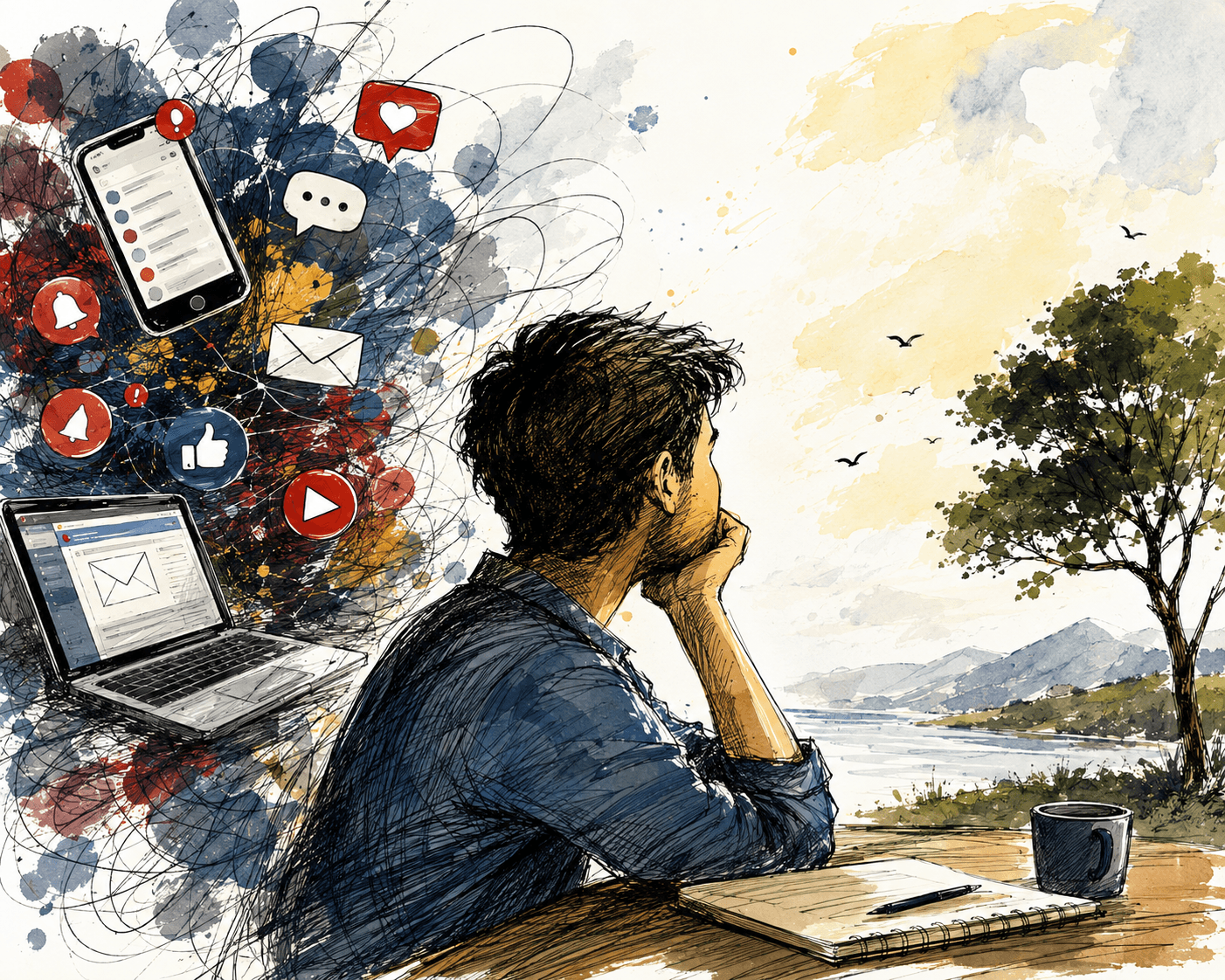
August 30, 2026Take a look at the screen in front of you. How many tabs are open on your browser? Or how many windows open in your phone.
How many unread emails glow softly on your phone like digital embers? When was the last time you sat in silence, uninterrupted, and simply thought? Every morning, before many of us have properly opened our eyes, we reach for our phones, nestled against our soft pillows.
"Stay connected with Aman-e-Pakistan for ongoing live reporting and verified investigative updates."
With sleep still in our eyes, we begin to check notifications. Before getting out of bed, we scroll through headlines, messages, reels and updates from people we may not have spoken to in years. We tell ourselves that we are only checking the time, yet somehow fifteen minutes disappear.
Then the day begins. A student sits down to study but keeps her phone beside her. A notification arrives, she checks it, one message becomes a video and one video becomes several.
When she finally returns to her textbook, the words seem strangely difficult to absorb. A professional begins an important task but repeatedly moves between email, Whats. App and social media.
At dinner, a family sits around the same table while several members look at different screens. Nobody has physically left the room, yet attention has. We live in an age of miracles.
We carry the sum of human knowledge in our pockets. Yet, we have never felt more scattered, more fragmented, more absent from our own lives. We are suffering from a collective crisis of attention, and it is not merely costing us our productivity; it is costing us our very sense of being.
The common narrative suggests we are simply lazy or lacking in willpower. The solution, we are told, is to download another productivity app, set timers, or lock our phones in a drawer. But this is a superficial remedy for a profound wound.
The problem is not just our gadgets; it is a philosophical crisis about what it means to be human in an age of infinite stimulation. The attention economy. We call it the "attention economy," but this phrase is a lie.
An economy implies exchange, value, mutual benefit. What we are actually experiencing is a "distraction extraction industry. " The business model is simple: the longer you look, the more they earn.
Every red notification badge, every autoplay video, every "pull-to-refresh" mechanism is engineered by brilliant minds to hijack your brain's reward system. A traffic signal becomes a chance to check Instagram. A pause during a conversation becomes an excuse to open Whats.
App. We have almost eliminated empty space from our lives. Yet empty space is not necessarily wasted space.
It is often where reflection begins. A mind that is constantly stimulated has little opportunity to wander, connect ideas or simply observe. We have become so uncomfortable with silence that we immediately fill it.
The ancient Stoics and Buddhist philosophers warned us about this. Epictetus taught that we suffer not from things themselves, but from our judgments about them. The Buddha spoke of the "monkey mind" restless, jumping from branch to branch, never at peace.
Today, we have built an entire civilisation that feeds the monkey mind that monetises restlessness which profits from our inability to sit still. We are not failing to pay attention; our attention is being systematically harvested.
We are not weak; we are fighting a multi-trillion-dollar machine designed to break our consciousness into tiny, sellable fragments. What does it mean to pay attention? Before we ask how to fix our attention, we must ask a deeper question: What is attention, and why does it matter?
The French philosopher Simone Weil wrote that, "Attention is the rarest and purest form of generosity. " To pay attention to something truly and deeply is to give it the gift of your presence. It is an act of love.
When we cannot pay attention, we cannot love. We cannot understand. We cannot be fully alive.
The crisis of attention is not just about productivity or focus. It is about our capacity for meaning. When we are perpetually distracted, we live on the surface of life.
We skim, we scroll, we consume but we do not inhabit our experiences. We are like tourists in our own existence, always photographing the moment but never living it. The German philosopher Martin Heidegger warned of this.
He spoke of "calculative thinking", the mode of mind that sees everything as a resource to be optimised, measured, and exploited. He contrasted this with "meditative thinking", the slow, contemplative awareness that lets things reveal themselves.
We have become masters of calculative thinking and amateurs of meditation. We know the price of everything and the value of nothing. Faiza Khan, a psychologist, argues that the attention crisis among young people is not simply a matter of excessive phone use; it is also a failure of guidance.
“We give children smartphones before teaching them how to manage their attention,” Khan explained, while talking to The Express Tribune. Parents often focus on limiting screen time, but do not teach children why certain content is difficult to resist or how algorithms keep them engaged.
Schools, too, rarely teach students how to manage digital distractions. “Young people need guidance, not restrictions.
They need to learn when to disconnect, how to recognise unhealthy digital habits and how to use technology without allowing it to control their daily lives, which requires parents and teachers to become role models rather than simply imposing rules.”Reading a book feels slow, studying feels boring and listening to another person feels demanding.
Aristotle's lesson would be that a good life is not necessarily the life containing the greatest amount of stimulation, but one in which our faculties are directed towards worthwhile ends. At the root of this crisis is our terror of being alone with our thoughts.
We reach for our phones in elevators, in checkout lines, even while the kettle boils. We have lost the capacity to bear boredom. But boredom is not an emptiness to be filled; it is a space to be inhabited.
The philosopher Blaise Pascal wrote in the 17th century: "All of humanity's problems stem from man's inability to sit quietly in a room alone. " This was true three hundred years before the smartphone. Today, it is our daily reality.
Boredom is the doorway to creativity. It is where the mind wanders, where unexpected connections form, where the soul speaks. When we fill every moment with stimulation, we starve our inner life.
We become hollow, reactive creatures, always responding but never reflecting. The solution, therefore, is not another app. It is a philosophical reorientation.
We must learn to see boredom not as an enemy but as a friend. We must cultivate what the ancient Greeks called ataraxia—a state of tranquil equanimity that is not dependent on external stimulation. The ethics of attention.
We must also recognise that this is not merely a personal problem. It is an ethical one. We have built a society that treats attention as a commodity to be extracted, rather than a sacred capacity to be nurtured.
The philosopher Byung-Chul Han argues that we live in an "achievement society" where we exploit ourselves in the name of productivity. We answer emails at midnight and boast about how little we sleep. We wear our exhaustion like a badge of honour.
This is not virtue; it is a form of collective self-harm. The solution requires a shift in values. We need to champion what the psychologist Cal Newport calls "deep work" the ability to focus without distraction on cognitively demanding tasks.
But more than that, we need to champion "deep living" the ability to be present, to listen, to love, to create, without the constant hum of digital noise. We need to teach our children and ourselves that reading a long, complex book is more valuable than skimming a hundred headlines.
That a single hour of focused conversation is richer than a thousand text messages and that a walk in the woods without headphones is a form of meditation. The education sector has an important role to play.
Digital literacy should go beyond teaching students how to use technology. They should learn how algorithms shape what they see, how misinformation captures attention, and how constant multitasking affects concentration. Being digitally literate means not only knowing how to find information, but also understanding why it is being shown to you.
There is also a key responsibility of technology companies. If certain design features encourage compulsive use, responsibility cannot rest entirely with the individual user. Healthier defaults, greater transparency around recommendation systems, stronger protections for young users and easier ways to disable autoplay and unnecessary notifications can all help.
The digital environment is designed, and what is designed can also be redesigned. The light at the end of the screen. So, is there a solution to the crisis of attention?
Yes, but it is not a quick fix. It is a slow, deliberate act of rebellion against the machinery of distraction. It is choosing to read a physical book while your phone charges in another room.
It is going for a walk without headphones and listening to the wind. It is looking someone in the eye during a conversation instead of glancing at the screen buzzing in your pocket. It is reclaiming your right to be bored, to be silent, and to be still.
It is recognizing that your attention is not a resource to be harvested but a gift to be given to your work, to your loved ones, to yourself. The Stoic philosopher Marcus Aurelius wrote: "The happiness of your life depends upon the quality of your thoughts.
" In an age of infinite distraction, the quality of our thoughts is under siege. But we have a choice. We can continue to be passive consumers of noise, or we can become active stewards of our own consciousness.
The world is loud. It is trying to sell you panic and distraction at every turn. The solution is not to shout louder.
The solution is to turn down the volume, take a breath, and remember that the most valuable real estate in the world is not on a screen; it is between your ears. Mindfulness revolution. Here is my honest view: I believe we are at a crossroads.
The same technology that connects us also fragments us. The same tools that inform us also numb us. We cannot simply reject technology that would be naive and impractical.
But we also cannot continue to surrender our attention without a fight. I think the solution lies in a kind of philosophical mindfulness. We need to be aware of the forces shaping our minds, and we need to consciously choose how we engage with them.
This is not easy. It requires discomfort. It requires saying no to the dopamine hits and yes to the slow, patient work of living.
But I am optimistic. I believe that more people are waking up to this reality. I see a quiet revolution brewing: people putting down their phones, rediscovering the joy of silence, reclaiming their attention as an act of defiance.
This revolution will not be televised. It will not trend on social media. It will happen in living rooms, in parks, in libraries, in the quiet spaces between thoughts.
And that, perhaps, is exactly the point. The solution to the crisis of attention is not something we will find by looking harder. It is something we will find by looking away by turning off the noise and turning inward.
It is a practice. It is not a product but a way of being. Reclaim your attention.
Reclaim your life. And before giving your attention to anything, ask:Is this worth a piece of my life? Rabia Khan is a freelance writer and researcher focusing on social issues, gender rights, and current affairs.
She can be reached at rabiayousufzai26@gmail.com. All facts and information are the sole responsibility of the writer. Pages.
Pakistan. Business. World.
Opinion. Life & Style. Sports.
Blogs. Videos. Our Sites.
Express News. Urdu E-Paper. English E-Paper.
Sindhi E-Paper. Cricket Pakistan. Express Live.
Campus Guru. Express Entertainment. Food Tribune.
About Us. Contact Us. Online Advertising.
Privacy Policy. Copyright. Fuel Prices Pakistan.
Gold Prices Pakistan. Prayer Timing Pakistan. Weather Forecast Pakistanfollow us
Written by Madiha Imam
Aman-e-Pakistan Senior Journalist & Bureau Reporter
Continue Reading: More in Tech
Swipe or click arrows to explore Tech desk coverage