Tech pilgrims flock to China as global innovation race heats up
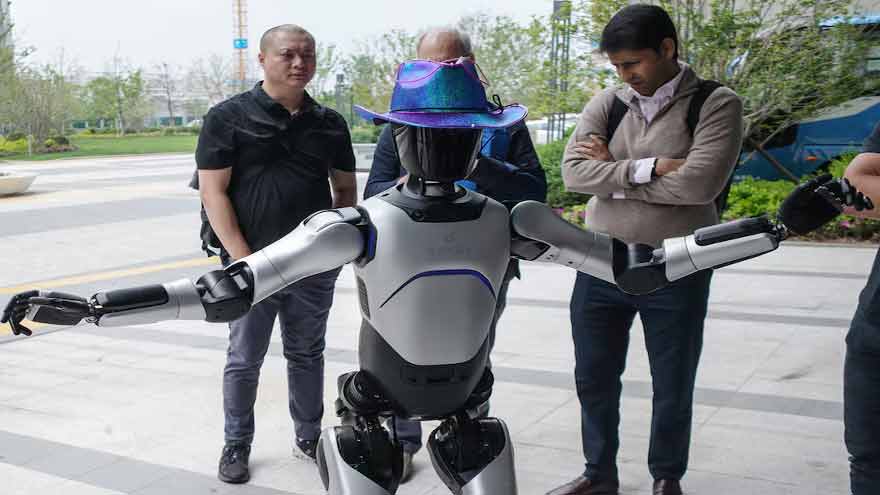
“Humanoid robots working on factory floors, AI models challenging global rivals and electric-vehicle plants churning out cars at breathtaking scale are drawing a new wave of foreign visitors to China. I…”
Investors and entrepreneurs are paying thousands of dollars for rare access to Chinese factories, seeking a front-row seat to what many believe could be the next technological revolution. The influx reflects mounting fears of a "China shock 2.0", with Western boardrooms and capitals confronting the possibility that Chinese companies are seizing the lead in advanced manufacturing and cutting-edge technologies.
"Right now, people are looking at China as an object of study and learning — a trend that barely existed just a few years ago," says Robert Wu, CEO of Shanghai-based data research firm Baiguan.
He noted that visitors often arrive with misconceptions — for instance, assuming China's robotaxi sector leads the U.S., when domestic policy caution around potential job losses actually keeps it a step behind. Wu has organised two tours for more than two dozen investors, entrepreneurs and executives so far, charging up to $15,000 for a five-day programme.
"Stay connected with Aman-e-Pakistan for ongoing live reporting and verified investigative updates."
Around half the participants came from Southeast Asia. He is part of a growing cottage industry catering to foreign demand for first-hand access to China's innovation ecosystem. Many attendees avoid publicising their visits.
Among those known to have made the trip are U.S. investment firms Dimension, Capital Group and Thrive Capital, as well as U.S. tech podcaster Lex Fridman. While data on tech tours is scarce, broader industrial tourism is booming.
China's industrial tourism sector pulled in $17.8 billion last year,, and is projected to blow past 300 billion yuan ($44.6 billion) by 2029. Shanghai-based tech tour agency Glo. Pen says inquiries jumped 50% in 2026 from mostly European and Singaporean clients, and it now runs over 100 single-day company tours every month.
"You cannot grasp the true scale, speed, and physicality of Chinese innovation without standing on the factory floor," says Bertrand Chen, CEO of the Global Shipping Business Network, who joined an April three-city robotics and emerging tech tour organised by Chinese American investor Rui Ma.
Ma, founder of Tech Buzz China and organizer of 11 such tours since 2019, frames it as essential due diligence: "Even if you're not actively investing in China, you're increasingly likely to encounter Chinese companies as competitors, partners, suppliers, or investments in markets around the world.
"The circuit spans Beijing, Shenzhen, Shanghai, Hangzhou and Hefei, the industrial powerhouses at the heart of China's electric-vehicle, battery, AI and robotics boom. World leaders have also flocked to Xiaomi's (1810. HK) Beijing auto factory, while Germany's Chancellor Friedrich Merz was famously filmed watching Unitree's (688836.
SS) dancing humanoid robots in Hangzhou, a high-profile showcase of the country's technological ascent. FEAR OF FALLING BEHINDNone of this is happening by accident. Beijing has explicitly pledged to "vigorously promote" industrial tourism, designating over 140 official demonstration sites.
A growing number of factories are offering public tours at around $60 a pop. Xiaomi's EV factory has welcomed more than 250,000 visitors since March 2024. Demand is so intense that lottery-awarded entry slots are scalped online for up to 2,000 yuan ($300).
For European executives wrestling with sluggish productivity growth and fears of falling behind in AI and robotics, China has become a particularly important destination. Alex Shengyun Lu, a Shanghai-based AI consultant at Praxis Advisory, has led seven delegations of up to 50 corporate visitors since late 2025 and describes an uneasy mood.
"The smartest people in Europe are acutely aware of the situation. The insecurity is palpable," he says. Executives typically arrive seeking answers to two questions, Lu said: what they can learn from Chinese companies and from China's state-backed approach to technology investment.
"They are coming here with a genuine mindset of humility and learning. "Lu, who declined to name the companies due to confidentiality agreements, says many European executives want to understand how China coordinates AI deployment across provinces at scale and what lessons can be applied back home.
Still, some industry observers caution against overstating China's advantage. "Non-Chinese (tech) companies still have most of the global market share, the most advanced IP, and the biggest profits," Tech Buzz founder Ma says. Even so, the flow of tech pilgrims remains strong, including American visitors despite escalating U.S.-China technology tensions.
"The people who are actually on the ground trying to build physical products don't care about the politics at all," says Joshua Woodard, a U.S. manufacturing consultant based in Shenzhen. "U.S. robotics companies still heavily source components and hardware from China.
We pretend we can do it all ourselves in America, but it is incredibly hard to completely decouple. "SHENZHEN MOMENTNo city embodies the trend more than Shenzhen. The southern technology hub is positioning itself as a showcase for Chinese innovation as it prepares to host this year's Asia-Pacific Economic Cooperation forum in November.
Foreign visitor numbers rose 70% last year, and jumped over 30% in the first quarter, with over 5 million entries recorded this year through August. Taxis now carry English-language announcements and foreign influencers regularly appear at tech exhibitions.
Local firms are even establishing Silicon Valley-style "hacker houses" for foreign robotics and AI hardware entrepreneurs to live and work,. "There are We. Chat groups with 400 people bouncing between Silicon Valley and Shenzhen, casually crowdsourcing battery or display factories," says Woodard, who runs Shenzhen factory tours for foreign entrepreneurs in his spare time.
"Founders are dropping in cold on the 10-day visa-free entry policy... just trying to suss out who can build their next prototype. "The influx highlights Shenzhen's transformation from a low-cost production hub to the front line of China's push for technological leadership.
Czech entrepreneur Jan Smejkal, who has lived in the city for 11 years, says scarcely a day passes without a request from foreign startup founders keen to visit. "There is no other place on earth that takes technology to its core and integrates it into daily life quite like Shenzhen.
"
Continue Reading: More in Tech
Swipe or click arrows to explore Tech desk coverage