K-P governor's rule to end in six months, emergency to continue until peace restored: Tariq Fazal
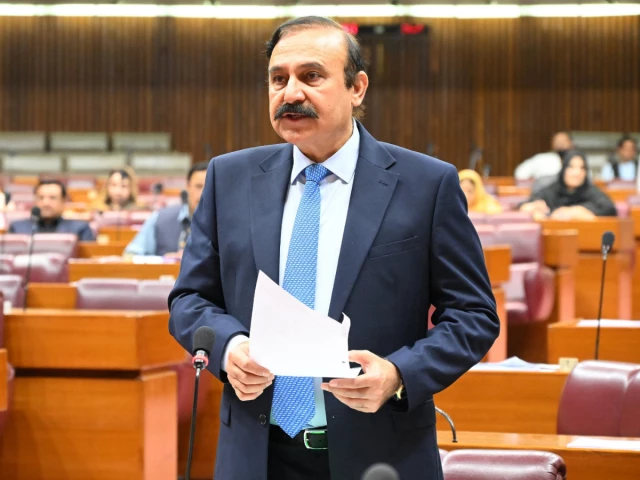
“Minister for Parliamentary Affairs Dr Tariq Fazal Chaudhry said governor's rule in Khyber-Pakhtunkhwa (K-P) would end after six months, while the emergency would remain in place until peace was restor…”
Responding to remarks by Jamiat Ulema-e-Islam-Fazl (JUI-F) chief Maulana Fazlur Rehman and Pakistan Tehreek-e-Insaf (PTI) Chairman Barrister Gohar Ali Khan in the National Assembly on Wednesday, Chaudhry said the government aimed to restore peace within six months. “Governor's rule will end after six months.
As for the emergency, our objective is to restore peace within six months, and we pray to Allah Almighty that we achieve this goal. The emergency will remain in place until peace is restored,” he said.
The minister clarified that governor's rule had been imposed throughout K-P under Article 234 of the Constitution, while the emergency had been imposed across the province under Article 232 in response to internal and external security threats.
"Stay connected with Aman-e-Pakistan for ongoing live reporting and verified investigative updates."
He rejected suggestions that the measures were limited to 12 districts, saying the entire province was under the governor's rule and emergency, while the 12 most terrorism-affected districts had been granted special status., the special arrangements would allow police and security agencies in those districts to seek assistance directly from the federal government without going through the chief minister's or governor's secretariat.
He maintained that the measures were intended to restore peace and improve administration rather than seize political power. Defending the government's decision, Chaudhry said extraordinary circumstances had required extraordinary measures, while maintaining that the government respected democracy, the Constitution and public opinion.
He said peace in K-P was directly linked to peace throughout Pakistan and that the lives of citizens and security personnel were equally valuable.
Chaudhry also disclosed that Prime Minister Shehbaz Sharif had approved a Rs160 billion package for K-P during an Apex Committee meeting at Governor House in Peshawar, attended by the Chief of Defence Forces and Chief of Army Staff, Field Marshal Asim Munir, the provincial governor, and senior civilian and military officials. Read:Ministers hit out at Fazl over K-P remarks.
He said the package would be implemented in three phases, beginning with strengthening the capabilities of the provincial police through modern weapons, armoured vehicles, equipment and training. The second phase would focus on healthcare, education, sanitation and infrastructure development, while the third would involve completing projects that had remained pending during the previous 12 years of PTI rule.
The minister said the largest share of the Rs160 billion allocation would be directed towards the 12 most severely affected districts. He said the government aimed to clear these districts of terrorists within four to six months while strengthening police capabilities.
Once the police were adequately trained and equipped, responsibility for maintaining law and order would be handed over to them to prevent militants from returning and allow development activities to proceed.
Responding to PTI's Gohar allegation that a particular political party was being installed in K-P, Chaudhry said the advisory council and council of elders established after the imposition of governor's rule did not include representatives of any political party. He maintained that no political party had been given a share in the powers previously exercised by the provincial government.
The minister said the government's priority was to restore peace and improve administrative affairs. Turning to negotiations with PTI, Chaudhry recalled talks held on October 2 under the chairmanship of National Assembly Speaker Sardar Ayaz Sadiq.
The minister said the PTI delegation included Gohar, Asad Qaiser, Amir Dogar, Raja Nasir Abbas and Salman Akram Raja, among others. Chaudhry acknowledged that PTI representatives had expressed a willingness to cooperate in combating terrorism during the negotiations.
He said Interior Minister Mohsin Naqvi had presented seven points concerning counter-terrorism cooperation, including condemnation of terrorism, elimination of terrorist safe havens, withdrawal of proposed amendments to the Police Act, implementation of the National Action Plan and cooperation with federal authorities and law enforcement agencies., PTI representatives had offered cooperation beyond the seven points during the negotiations.
However, he maintained that the opposition delegation lacked the authority to finalise an agreement. Chaudhry said the proposed agreement had been sent to the K-P leadership, which suggested changes, leading to several revised drafts., non-functional K-P Chief Minister Sohail Afridi rejected successive proposals, including a fourth draft prepared at approximately 2:30am, after which negotiations ended.
Chaudhry maintained that condemning terrorism verbally was insufficient without practical cooperation with security institutions. He stated that the K-P chief minister had publicly declared during a long march that he would not cooperate with security forces or support federal counter-terrorism measures.
Chaudhry said the provincial leadership's position had contributed to the circumstances that led to emergency and governor's rule. Responding to allegations of political victimisation, Chaudhry maintained that operations in K-P were directed against terrorists and individuals challenging the government's authority rather than any political party.
He said the operations targeted those involved in bombings, infiltration and attacks on civilians and law enforcement personnel. The minister also questioned the opposition's position on previous long marches, asking why earlier protests had been led by provincial chief ministers and why the latest march had not been organised under PTI's provincial president.
Referring to the impact of terrorism on political parties, Chaudhry recalled that the JUI-F chief had spoken about the deaths of approximately 250 party workers and had himself survived several suicide attacks. He said political leaders in K-P were also vulnerable to terrorist attacks, alongside police, Frontier Corps personnel and other security agencies.
Chaudhry referred to attacks in Bannu, Kurram and Lakki Marwat, saying police officers and personnel had lost their lives in terrorist incidents. He also mentioned the recent deaths of a deputy superintendent of police and other personnel.
The minister stressed that every human life was valuable and that the suffering of families who had lost relatives to terrorism could not be ignored. He said the provincial administration's cooperation was essential to preventing further casualties and ensuring the success of counter-terrorism operations.
Chaudhry also criticised PTI's record in K-P, noting that the party had governed the province for more than 12 years. Turning to Afghanistan, Chaudhry said Pakistan had initially pursued negotiations and diplomatic engagement to address cross-border terrorism.
He said Islamabad had approached friendly Muslim countries and participated in talks in Doha and Istanbul, where evidence of terrorist safe havens and cross-border infiltration had been presented to Afghan representatives in the presence of officials from the countries facilitating the negotiations., Afghan representatives had neither rejected the evidence nor described it as contrary to the facts.
However, he said that the Afghan side had maintained it could not eliminate terrorist training centres or prevent infiltration. Chaudhry said Pakistan had exhausted diplomatic options before adopting its current Afghanistan policy and urged the Afghan authorities to eliminate terrorist safe havens and prevent terrorists from crossing into Pakistan.
He criticised contradictory approaches towards Afghanistan, saying a provincial government could not pursue a foreign policy different from that of the federal government. Read more:K-P emergency proposal not linked to PTI long march: Tariq Fazal.
Referring to suicide attacks involving Afghan nationals, he questioned why some political figures appeared more sympathetic towards Afghanistan than Pakistan. The minister also rejected comparisons between the security situations in K-P and Balochistan, saying the circumstances in the two provinces were different.
He maintained that the Balochistan chief minister was cooperating with federal authorities, the armed forces and security agencies in combating terrorism.
Chaudhry also pointed to differences in geography and population, saying Balochistan accounted for approximately 43% of Pakistan's land area and had a population of around 10 million, compared with approximately 45 million in K-P., terrorists in Balochistan frequently emerged from mountainous areas, carried out attacks and withdrew.
He said that foreign intelligence agencies were financing and equipping terrorist groups operating in Balochistan, claiming that more than two countries were involved in supporting such activities. Chaudhry said that India was playing a leading role in supporting terrorism in Balochistan and that foreign-backed groups sought to destabilise Pakistan and prevent the success of Gwadar Port.
Turning to concerns about provincial mineral resources, the minister rejected suggestions that the measures imposed in K-P were intended to facilitate control over the province's natural wealth. He referred to remarks by US diplomat Natalie Baker concerning mineral resources in K-P and Balochistan and the willingness of American companies to cooperate in their exploration.
Chaudhry maintained that American companies were involved in mineral exploration around the world and that their interest in Pakistan should not be interpreted as an attempt to seize provincial resources.
He also referred to disruptions in the Strait of Hormuz and the wider Gulf region, saying Pakistan had suffered from rising energy prices while the United States was comparatively less affected because of its domestic resources. The minister acknowledged that the people of each province had the first right over their mineral resources.
However, he argued that developing those resources was necessary to generate revenue for healthcare, education and other public services. He questioned whether mineral resources that had remained underground for decades should continue to remain unused.
Chaudhry maintained that no province had any claim over another province's mineral wealth and that the purpose of the arrangements in K-P was to restore peace rather than gain control over resources.
Turning to Kashmir, the minister said the issue was close to his heart and maintained that the government had made every possible effort to address the region's problems through dialogue and peaceful means. He referred to electricity subsidies in Azad Jammu and Kashmir (AJK), saying consumers there were being charged Rs3 per unit without separate peak-hour tariffs.
Chaudhry contrasted this with higher electricity charges elsewhere and said the arrangement had been introduced in response to the demands of the Kashmiri people. He also referred to subsidised flour, saying a 20-kilogram bag was being provided for Rs2,000 in AJK, adding that Islamabad was providing these subsidies and would continue supporting the people of the region.
The minister maintained that attempts to create divisions between Pakistan and Kashmir should not be allowed to succeed. Concluding his remarks, Chaudhry called for political parties to develop a consensus on national security, counter-terrorism and economic stability.
He said Prime Minister Shehbaz and senior cabinet members remained willing to engage the opposition in dialogue. The minister proposed three areas for agreement: strengthening Pakistan's internal and external security, eliminating terrorism and improving the economy.
He described the proposed objectives as a “stable Pakistan, a secure Pakistan and a prosperous Pakistan”. Also read:Tariq Fazal rubbishes linking governor's rule in K-P to mineral extraction. Chaudhry maintained that negotiations were the only way forward and that the government had never advocated political confrontation.
He also contrasted the conduct of the prime minister with that of former prime minister Imran Khan towards opposition leaders. Chaudhry said that Imran had avoided interacting with the opposition leader during his tenure, while PM Shehbaz regularly approached opposition members, greeted them and expressed a willingness to hold talks.
He said the government was prepared to sit with the opposition and develop a consensus on national priorities, particularly security, counter-terrorism and economic stability.
Gohar accuses govt of political victimisation under K-P emergencyPTI Chairman Gohar accused the federal government of carrying out political victimisation under the cover of emergency and governor's rule in K-P, warning that continued action against political opponents would further aggravate the situation.
Addressing the NA, Gohar reiterated his party's opposition to the imposition of emergency and governor's rule, alleging that political victimisation in the province had reached an unprecedented level. He maintained that action under the National Action Plan should be taken without discrimination and rejected allegations that PTI had engaged in retaliatory measures.
Gohar said that PTI workers were being stopped and arrested, accusing the government of undermining democratic values. “You are beginning to dismantle democratic values,” he said, adding that the provincial administration had effectively been taken over even before governor's rule was imposed.
Referring to the whereabouts of K-P chief minister, Gohar claimed that his whereabouts remained unknown. He also said that the PTI founder's three sisters had been kept in jail. “Pakistan first,” he said, warning that continued political victimisation would further complicate the situation.
Gohar demanded that the authorities produce the party's parliamentarians and expressed concern over the condition of Iqbal Afridi and Junaid Akbar, saying they required medication. He also criticised restrictions on meetings with PTI founder Imran, claiming that 375 days had passed without a meeting.
The PTI chairman called for an end to the practice of picking up people and making them disappear, saying such actions should no longer continue. “We are democrats. We are not people who storm institutions,” he said.
Gohar warned that the prevailing circumstances would eventually pass, while reiterating his allegation that the federal government was using the emergency to target political opponents.
JUI-F chief calls for new Charter of Democracy, accuses govt of misusing ConstitutionJUI-F chief called for a new Charter of Democracy between the government and opposition, accusing the federal government of misusing the Constitution to impose emergency and governor's rule in K-P.Addressing the NA, Fazl said Parliament was a representative institution of the people, but political tolerance had diminished, and the situation in the country was continuing to deteriorate.
He urged the government and opposition to sit together and reach a new political agreement to prevent further confrontation and violence. “Come, let us sit at one table and establish a new Charter of Democracy,” he said, stressing that both the government and opposition should be part of the process.
Referring to the negotiations held before PTI's planned long march towards Islamabad, Fazl said party representatives had approached him and requested that he play a role in resolving the situation.
He recalled that government representatives, including Rana Sanaullah, had visited him the following day and held detailed discussions on the matter., he subsequently received a telephone call from the Prime Minister's Office inviting him to dinner.
He said he accepted the invitation and held detailed talks with PM Shehbaz, who asked him to persuade PTI to call off its long march. However, Fazl said Deputy Prime Minister Ishaq Dar called him and informed him that the cabinet was unwilling to accept the proposed arrangement.
He maintained that his efforts had been aimed at resolving the dispute peacefully and preventing bloodshed. The JUI-F chief criticised the subsequent imposition of emergency and governor's rule in K-P, rejecting the government's argument that it had completed the constitutional procedure.
“The government has misused the Constitution,” he said that the transfer of power had been carried out through force. He questioned why similar measures had not been imposed in Balochistan, where he claimed the security situation was also serious.
“Are conditions in Balochistan not worse than this?” he asked, referring to incidents in which commissioners had been abducted. He also said he had heard reports that the son of the Khan of Kalat had been abducted.
Turning to the broader political situation, Fazl said the country lacked effective constitutional and democratic governance. He maintained that political disputes should be resolved through dialogue and mutual understanding rather than confrontation. The JUI-F chief recalled his role during difficult periods faced by parties now sitting on the government benches.
He said government lawmakers should remember the time when he had stood at the forefront of political struggles on their behalf. Referring to the Pakistan Democratic Movement (PDM), Fazl remarked that its “head is on one side and its body on the other”, highlighting the divisions among its former political allies.
In a lighter exchange with government lawmakers, Fazl said his party had not engaged in political confrontation for some time. “We had not fought for quite some time, and our hands are itching for a fight,” he remarked.
Members on the government benches responded that they had not fought either and that their hands were also itching for a fight. Fazl reiterated that political matters should be settled through brotherhood and negotiations rather than confrontation.
He maintained that he had made repeated efforts, including holding discussions late into the night, to prevent the country from descending into violence. The JUI-F chief said he was prepared to make sacrifices to protect the country from unconstitutional measures and bloodshed.
“We are prepared to die at your hands, but we are not prepared to die at the hands of history,” he said. During his address, Fazl also referred to diplomatic negotiations taking place in Tehran, questioning why senior government officials were present in the NA while the talks were underway.
He specifically referred to Defence Minister Khawaja Asif and PM Shehbaz, making a pointed remark about the need to preserve dignity and respect. “There should be some shame, some modesty,” he remarked while looking towards Khawaja Asif with a smile, prompting laughter in the House.
Fazl again urged the government and opposition to work towards a new Charter of Democracy, maintaining that political dialogue was necessary to safeguard the country's future. He said all political parties should agree on a framework to prevent unconstitutional actions and violence.
During the proceedings, NA Speaker Ayaz Sadiq said he would listen to Fazl's speech but would expunge any unparliamentary language from the record. The JUI-F chief concluded by reiterating that Pakistan belonged to all its citizens and that the country's political future should be determined through constitutional and democratic means.
With additional input from Web Desk
Continue Reading: More in National
Swipe or click arrows to explore National desk coverage