CDF Asim Munir vows security for mining sector to attract long-term mineral investment
“Chief of Defence Forces and Chief of Army Staff Field Marshal Syed Asim Munir on Friday pledged to ensure security across Pakistan's mining sector as part of efforts to attract long-term mineral inves…”
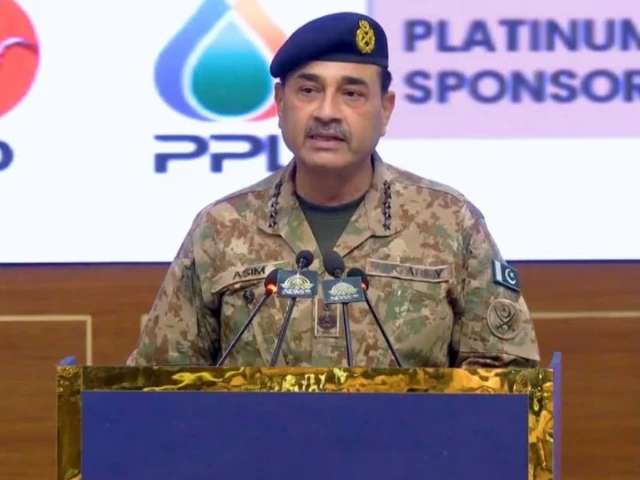
Addressing participants on the second day of the two-day Pakistan Minerals Investment Forum (MIF) 2026 in Islamabad, the field marshal said every possible measure was being taken to ensure the security of the entire mining sector. He assured that mines, miners, investments, industries, projects and people associated with the sector would be provided protection.
Field Marshal Munir said Pakistan aimed to become a competitive destination for long-term mineral investment, stressing the importance of creating a secure environment for mining activities and related industries. He said unlocking Pakistan's mineral wealth was a collective national objective and emphasised that the country needed to move beyond exporting raw materials.
The army chief said the objective was to develop the entire mineral value chain, including refining and manufacturing, to generate greater economic benefits. He added that Pakistan wanted to establish long-term partnerships that would create sustainable economic value for the country and its international partners.
"Stay connected with Aman-e-Pakistan for ongoing live reporting and verified investigative updates."
Field Marshal Munir also stressed that mineral development must benefit local communities, particularly those living in mineral-rich areas. He said people in these regions should see tangible improvements in their lives as a result of mining activities.
Highlighting the country's human potential, the field marshal said Pakistanis were hardworking, courageous and determined, with the ability to turn their aspirations into reality. He said the country's natural resources provided opportunities, while its people possessed the strength and determination required to achieve results.
The army chief called for a shift from potential to production, promises to implementation, and raw material exports to value-added economic growth. He concluded his address with the slogan, "Pakistan Hamesha Zindabad. "Read:Finance minister dubs mining sector a ‘game-changer’ for Pakistan’s economy at investment forum in Islamabad.
Earlier, Petroleum Minister Ali Pervaiz Malik said Pakistan would offer investors clear and uniform fiscal terms for mining projects, without requiring "case-by-case" negotiations, as the government sought to attract long-term investment in the country's mineral sector. Malik said, “Our aim is straightforward.
We want clear fiscal terms available to every responsible company without the need to negotiate special arrangements on a case-to-case basis. "The forum brought together international investors and government officials as Pakistan sought to attract foreign investment in its mineral sector, with provincial leaders outlining investment opportunities, incentives and development plans.
“Terms that are attractive and fair for investors, to the provinces and to the federal government alike,” he added. The minister said the government was also committed to providing "security and safety for the mine sites, logistics and above all trained human resources.
"“Special arrangements have been made to augment the security framework for uninterrupted operations of mines in a conducive environment,” he added.
Malik said the government was investing in better geological data, led largely by the Geological Survey of Pakistan, to help investors scientifically assess risks associated with mining projects.وفاقی وزیر علی پرویز ملک کا پاکستان منرلزانویسٹمنٹ فورم 2026 سے خطابpic.twitter.com/PX1uwXUMTQ— PTV News (@PTVNews.
Official)November 13, 2026“You cannot price risk for a project you cannot scientifically measure,” he said, adding that more than 40 mineral exploration licences had recently been granted in Balochistan's Chagai and Khuzdar districts, reflecting growing private-sector participation in strategic and critical minerals.
The government was also developing road connectivity between Chagai's mineral-rich belt and Gwadar port, as well as linking Thar coal to power plants, to facilitate transportation and connect mineral resources with international markets. “For too long, we have exported raw ore or concentrate and imported the finished products to meet our requirements.
We are now advancing copper smelting to capture more of the value chain from the mine to the finished metal,” Malik said. The minister said the government was accelerating geological mapping, including detailed surveys at a scale of 1:50,000, to identify mineral prospects across the country.
These included copper and gold in Chagai and western Balochistan, lithium, tin and tungsten in Gilgit-Baltistan, and antimony and base metals in Khyber-Pakhtunkhwa. The exploration programme was being supported by modern geochemical and geophysical surveys, exploratory drilling and upgraded research laboratories.
The minister also cited international technical cooperation, including the UK-Pakistan Geoscience Capacity Building Programme, as part of efforts to strengthen expertise in digital mapping, airborne surveys and mineral assessment. He said the government was digitising decades of geological information to provide investors with better access to reliable data, reduce exploration uncertainty and support informed investment decisions.
“Discovering a mineral deposit is only the beginning. A commercially viable mine requires power, water, roads, railways and access to international markets,” he said. In this regard, Malik identified the planned upgradation of the Rohri-Nokundi Railway Corridor, connectivity to Port Qasim and supporting infrastructure around Reko Diq as important steps towards linking mineral-rich regions with international markets.
“Our objective is very clear – to build not just individual mines but an integrated, competitive and sustainable mineral industry,” he said, adding that the government wanted investment to support processing, refining, downstream industries, technology transfer and integration into global value chains wherever commercially and technically viable.
The minister said the mining sector should also develop local capabilities through technical skills, vocational training, engineering services and a stronger base of Pakistani suppliers, while creating career opportunities for young people, including women entering the sector. He stressed that mining projects must deliver tangible benefits to communities in producing regions through improved livelihoods, skills, services and local opportunities.
Environmental management, safety standards and transparent community engagement were also essential to responsible mining, he added. Read more:Sindh's mineral sector open for investment: CM“Projects that earn the trust of the communities around them are, in our experience, the projects that actually get built and sustained,” Malik said.
The minister thanked Prime Minister Shehbaz Sharif and Field Marshal Asim Munir for their support in developing the country's mineral sector and invited international investors to bring forward proposed projects. He assured investors that the government would facilitate follow-up meetings, technical discussions, site visits and project evaluations.
“If you have a project in mind, kindly bring it to us and we will set out a clear path of follow-up meetings, technical discussions, site visits and project visits and project evaluation, not a vague promise to be in touch,” he said.
Addressing representatives of Barrick, Ivanhoe and Minmetals, among other investors and partners, Malik said Pakistan was open to long-term mining investment. “Pakistan is open for long-term mining investment, and we hope to earn your confidence through what we deliver from here, starting from how we follow up after this forum ends,” he said.
Continue Reading: More in National
Swipe or click arrows to explore National desk coverage