MQM-P postpones Nov 29 rally for new provinces, reiterates demand for administrative division
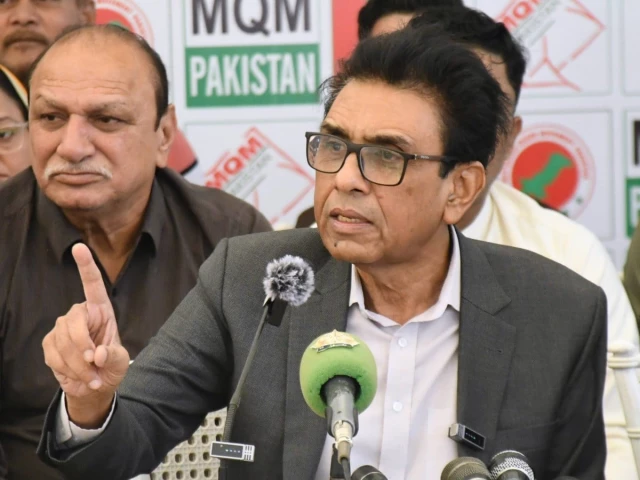
“Muttahida Qaumi Movement-Pakistan (MQM-P) Chairman and Education Minister Dr Khalid Maqbool Siddiqui on Thursday said his party had postponed its planned November 29 rally in support of new provinces …”
Addressing a press conference at the party's Bahadurabad headquarters, Siddiqui said a new date for the demonstration would be announced after consultations within the party. He maintained that provinces, like districts and divisions, were administrative units and should not be treated as the personal property of politicians.
“Just as districts and divisions are administrative units, provinces are administrative units too. We will not allow anyone to treat provinces as their personal estate,” he said. Siddiqui said the creation of new provinces was a political matter that should be resolved through democratic means, adding that administrative structures needed to be expanded in line with population growth.
“The demand for new provinces, which once emerged from the urban areas of Sindh, is now a demand across the country,” he added. "دھمکیاں ہم پر کارگر نہیں ہوتی ہیں۔ دلیل ہوگی تو مان لیں گے، سمجھ لیں گے۔"#Dr. Khalid.
"Stay connected with Aman-e-Pakistan for ongoing live reporting and verified investigative updates."
Maqbool. Siddiqui#ChairmanMQM#MQMPakistan#Bilawal. Bhutto.
Zardari#New. Provinces#Sindhpic.twitter.com/lQNY9hC9r6— Dr. Khalid Maqbool Siddiqui (@Conv_KMS)November 19, 2026The MQM-P chief maintained that his party was not seeking the creation of provinces on linguistic grounds but on the basis of population distribution. He said the debate over administrative restructuring should take place in parliament and through constitutional forums rather than being turned into a street confrontation.
Drawing a parallel with the expansion of districts and divisions over the past several decades, he questioned why provinces could not undergo similar administrative restructuring. He said the number of districts and divisions had increased over the past 50 to 60 years, arguing that provinces served the same administrative purpose.
Addressing criticism of the demand, Siddiqui said threats would not deter his party and that it was willing to consider arguments based on reason. “Threats do not work on us. If there is a logical argument, we will accept it and understand it,” he said.
He also criticised what he described as threats directed at residents of Sindh's urban areas, saying they could not be intimidated. “The people of Sindh's urban areas are not bonded peasants who can be threatened,” he said, adding that the demand for new provinces across the country “cannot be equated with treason”.
Criticism of PPPSiddiqui questioned the Pakistan Peoples Party's opposition to the creation of new provinces, accusing it of applying different political standards in different parts of the country. Referring to the 1970 general elections, he questioned the PPP's claim to being a national party, arguing that it had lacked representation in 55% of the country at the time.
He further alleged that the party had only linguistic roots. He said the PPP had formed a government at the Centre despite not having a majority in most provinces, and questioned why it had not implemented the quota system in Punjab, where it had secured a majority in the 1970 elections.
The MQM-P chairman also challenged PPP Chairman Bilawal Bhutto Zardari to explain why the party had singled out Karachi, Hyderabad, Mirpurkhas and Nawabshah in its opposition to the creation of new provinces.
He questioned whether the PPP's concerns were linked to the possibility of losing political control over these urban centres and made references to Uzair Baloch, Janu Arain and Qadir Magsi while questioning who would be involved in the alleged violence. "Is this a threat?
" Siddiqui asked, urging the authorities to take notice of what he described as provocation. He also called on the judiciary to take suo motu notice of the matter. He argued that the PPP opposed new administrative units because it feared losing control over areas that contributed more than 98% of Sindh's revenue.
He alleged that the provincial budget was not being spent proportionately in the areas generating the bulk of the province's economic activity. “Sindh's urban areas have the strongest arguments in favour of new provinces based on historical, political, legal, constitutional, economic and societal realities,” he said.
Siddiqui said questions would eventually be raised about the distribution of the legitimate revenue generated by Sindh's urban areas, followed by scrutiny of other alleged sources of income, including corruption, crime and land grabbing, which he claimed accounted for more than twice the province's declared revenue.
Without naming the Bhutto family directly, he criticised what he described as the concentration of wealth within a single political family, claiming its assets were worth more than Rs50,000-60,000 billion. He described the concentration of such wealth as an existential threat to the country and regretted that it had not translated into development even in Larkana, the PPP's political stronghold.
Citing the provincial Planning and Development Department, Siddiqui said poverty had declined in all provinces except Sindh. He questioned why the country's wealthiest province continued to experience widespread deprivation. “Sindh also has the highest number of schools and yet the worst literacy rate,” he said.
He also criticised the PPP over the controversial language bill introduced by the party in the provincial assembly in the past, urging it to learn from its previous mistakes and abandon what he described as divisive politics.
Siddiqui further alleged that the PPP had legitimate electoral support only in rural Sindh, while its governments elsewhere in the country had come through what he called the system's intervention. Census and constitutional mechanism. Turning to the 2023 census, Siddiqui accused the provincial government of undercounting Karachi's population, arguing that the city's high-rise buildings had not been properly accounted for.
Citing recognition of Karachi's population by the president and the then chief justice in 2008, he questioned the subsequent reduction reflected in the latest census figures.
He said the political will of 65% of Sindh's urban population was being ignored in the debate over the creation of new provinces, adding that Karachi and other urban centres had sufficient economic resources to finance new administrative units. “We will even give it to those who fall short [in the budget],” he said.
The MQM-P chief also questioned the constitutional mechanism for creating new provinces, arguing that provincial assemblies should not have the authority to determine the division of existing provinces when they had a conflict of interest in the matter. He maintained that the federal government should instead have the authority to initiate the process of administrative restructuring.
“We respect your mandate but you should refrain from provocations against us just because we are in favour of administrative division of Sindh,” Siddiqui said, addressing Bilawal. Bilawal advises govt to 'calm down' and hold a 'debate you started' on provinces.
On Wednesday, Bilawal responded after a day's worth of volley from government officials over his critical remarks and advised them to "calm down" and to proceed forward with the "debate you started" on the issue of more provinces and a referendum to solve the deadlock.
The remarks come after Defence Minister Khawaja Asifhitback at Bilawal earlier in the day over his criticism of the government and calls for a "political reset", questioning his moral standing to lecture others while pointing to the PPP's 18-year rule in Sindh. Minister of State for Interior Talal Chaudhry and Health Minister Mustafa Kamal also criticised Bilawal over his remarks.
A day earlier, Bilawal hadcalledfor a "political reset' to restore public confidence in state institutions, urging the government to revive dialogue with opposition parties, including the Pakistan Tehreek-e-Insaf (PTI), and end political victimisation.
The PPP scion, speaking in a private television channel talk show, "Faisla Aap Ka", reiterated that the economic woes brought about by regional conflicts had dealt a crushing blow to the masses, resulting in “economic collapse”. Read:Bilawal stirs political storm with no-holds-barred speech.
Bilawal stated: "We should calm down, and you started a debate, and now you should have the courage to continue it. This debate has not happened in parliament yet, and you decided to hold this debate in front of businessmen.
Pakistan is not so weak as a society that unilateral debates take place which everyone else has to accept. "“If someone is calling for a reset, I have a right to give my perspective regarding it,” he stated, outlining that he put forth his views at yesterday’s conference about the nature of the proposed change.
“I was clarifying whether the proposed reset needs to be political, apolitical, democratic or undemocratic in nature.”The PPP leader said he never backed down from his stance or viewpoint, explaining that he centred his conversation around the plight of the people.
“The elite are oblivious to the dilemma faced by the people of Pakistan in the face of this economic catastrophe. In light of these circumstances, all the political parties should put aside their differences and deliberate on ways to fix the system to give reprieve to the masses,” he remarked.
“We have to restore the confidence [of the people] in our institutions,” he added.
When probed on the need to give such a hard-hitting statement against the government, although he himself is part of the system and has active governments in Sindh, Balochistan and Khyber-Pakhtunkhwa, the PPP scion said, “I do have governments running the said provinces, and I acknowledge being a stakeholder in the system. These are reasons to listen to me.
These are not reasons to discard what I am saying.”Read more:'Are your hands clean? ': Khawaja Asif hits back at Bilawal over govt criticism. Outlining his responsibility as a major stakeholder, he said he had proposed solutions which could be set aside, but at least he deserved to be listened to.
“People should have the heart and the courage to bear and listen to the truth,” he stressed.
“You have observed the current geopolitical scene; at how many more fronts can they [government] lead a war?”He said that he was proud that Pakistan won the war against India, however, he cautioned that it would be naïve to believe that the eastern neighbour had given up its nefarious designs to hurt the country.
The PPP stalwart said the country was “almost at war” with Afghanistan, “heavily involved with Iran” during the ongoing conflict, battling Tehreek-e-Taliban Pakistan (TTP) and Balochistan Liberation Army (BLA) inflicted terrorism as well.
“Then the government decided to fight with Pakistan Tehreek-e-Insaf (PTI), asserted its will to confront Jamiat Ulema-e-Islam (JUI) and now that I have spoken the truth, they might as well decide to go to war with me too,” Bilawal remarked, lampooning the government’s approach.
He asked: if the state decided to "fight everyone", who would take the people out of their current misery and economic crisis?
Continue Reading: More in National
Swipe or click arrows to explore National desk coverage