Public transport carries less than 1% of commuters
“Pakistan's transport policy needs to shift its focus from private cars to public buses to make urban mobility more affordable, reduce carbon emissions and support local manufacturing, experts say, as …”
The Bus. Caro and Pakistan & Counting Mobility Index, launched on Thursday, showed that the cost of travelling a kilometre across eight modes of transport fell 7.9% between May and September, declining from Rs10.48 to Rs9.65.
However, the index's vehicle-based weight is heavily dominated by privately owned motorcycles, cars and rickshaws, which account for 98.7% of the total weight. The findings have renewed attention on the structure of Pakistan's transport system, where private cars and electric vehicles (EVs) frequently dominate automotive discussions despite limited car affordability and inadequate public transport options in major cities.
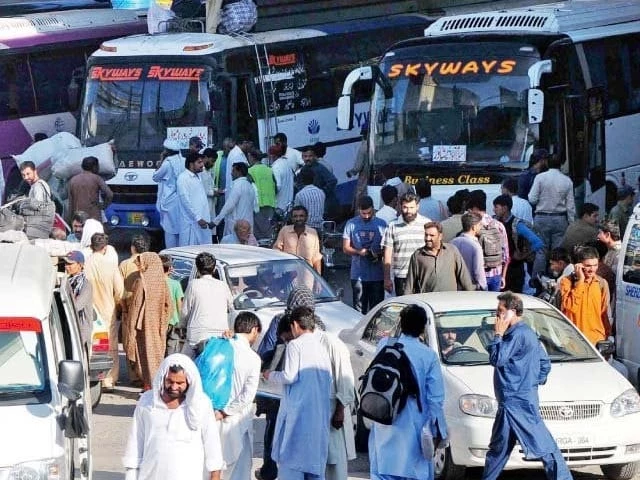
One industry argument is that buses make greater economic sense for a country where only around 22 people out of every 1,000 can afford a car. Expanding bus services could help transport a larger share of the population at a lower cost while reducing dependence on private vehicles.
"Stay connected with Aman-e-Pakistan for ongoing live reporting and verified investigative updates."
Developing local bus manufacturing could also reduce reliance on imported vehicles and components. Mashood Ali Khan, an auto expert, said public transport played a crucial role in urban centres and megacities, and cited examples from Europe, China and India, where transport networks had been developed to serve residents and businesses more efficiently.
"Routes and directions of public transport are very important so that they are convenient for the industry and residents coming within those routes," he said. Khan said developed transport systems had invested in infrastructure, including underground networks and flyovers, to make public transport convenient and clean.
Pakistan had also begun developing public transport systems, particularly in Punjab, followed by the federal capital and Sindh, but the pace of expansion needed to be accelerated. He called on the government to introduce policies and incentives to develop public transport rapidly and transition towards electric bus fleets.
He said the country needed to make public transport cleaner and more user-friendly to encourage commuters to shift away from private vehicles. He also proposed a coordinated national strategy under which all four provinces would identify their bus transport requirements, allowing the federal government to develop a long-term roadmap that could bring those needs together.
Rather than relying on imported buses, Pakistan should negotiate with established original equipment manufacturers (OEMs) to set up an electric bus manufacturing plant locally or develop domestic manufacturing capacity, he said. Such an approach could combine public transport expansion with industrial investment, local production and employment generation.
However, it would require a clear assessment of provincial demand, financing arrangements and the infrastructure needed to operate electric buses. Khan said infrastructure remained a major constraint, particularly in Karachi, Pakistan's economic hub, where deteriorating roads and inadequate transport facilities undermined the commuting experience.
"Due to the lack of infrastructure, it looks like we are travelling on a desert safari," he said, describing the condition of transport infrastructure in Karachi. He added that communication gaps between federal and provincial governments often delayed projects, increasing development costs.
Public transport, he said, should be treated as a basic necessity and developed under a time-bound, long-term national policy rather than through disconnected provincial initiatives. Khan argued that the scale of Pakistan's potential bus market could justify investment in domestic manufacturing.
He estimated that the country's existing bus fleet was around 2,000, while annual demand could reach 18,000 to 20,000 buses. The mobility index also highlighted the contrast between private and public transport costs.
While fuel-only running costs for privately owned motorcycles, cars and rickshaws fell 7.5% between May and September, the public transport component rose 77%, from Rs1.22 to Rs2.16 per seat-kilometre. The increase largely reflected the restoration of fares after Punjab's Metro Bus, Bus Rapid Transit and Orange Line services had been free for a period.
The index's public transport component therefore reflects a change in fares rather than simply an increase in operating costs. The index counts 36.7 million vehicles, including 30.3 million motorcycles and 5.1 million cars, based on the Pakistan Economic Survey 2024-25.
Continue Reading: More in National
Swipe or click arrows to explore National desk coverage