UN rights chief calls for Imran Khan’s release, urges political de-escalation
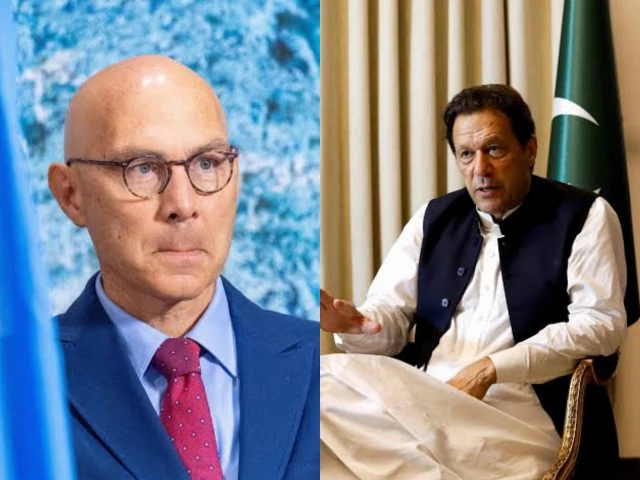
“United Nations human rights chief Volker Turk on Thursday called for the release of former prime minister Imran Khan, urging Pakistani authorities to ensure his proper treatment and take steps to ease…”
Imran and his wife, Bushra Bibi, remain incarcerated at Rawalpindi’s Adiala Jail. They were sentenced to 17 years in prison on Dec 20, 2025, in the Toshakhana-II case, which concerns allegations that they unlawfully retained a Bulgari jewellery set gifted by the Saudi crown prince during an official visit to Saudi Arabia.
Imran has been in custody since August 2023 and is serving a sentence in a £190 million corruption case. He also faces pending trials under the Anti-Terrorism Act in connection with the May 9, 2023, protests.
Read:'I may not return alive': Imran urges top judges to enforce court orders, ensure medical treatment. Turk’s appeal came days after Imran urged the country’s top judges to ensure the implementation of Supreme Court orders concerning his medical treatment and prison conditions.
"Stay connected with Aman-e-Pakistan for ongoing live reporting and verified investigative updates."
He warned that his health was deteriorating and that he could reach a point from which he might not “return alive”. “I call for [Imran Khan’s] release. I call for his proper treatment, and I actually call for de-escalation,” Turk said in an interview with CNN.“I call for [Imran Khan’s] release.
I call for his proper treatment, and I actually call for de-escalation,” says UN human rights chief@volker_turk. “We need to diffuse the political tensions that are around this case, which means that a confidence-building measure between the…pic.twitter.com/I6m6Kui.
KlZ— Christiane Amanpour (@amanpour)November 19, 2026“We need to diffuse the political tensions that are around this case, which means that a confidence-building measure between the opposition and the government could be his immediate release,” he said.
Asked what the UN could do to help address the situation, Turk said the organisation needed to continue engaging with Pakistani authorities and stressed that they must respect international legal standards governing detention.
“There is a broader context, I have to say, because it’s not just one very prominent case,” he said, adding that human rights defenders, journalists and people in the political opposition were also facing arbitrary detention.
“It’s absolutely clear, as I said, we need de-escalation, we need proper dialogue, and we need to respect international legal standards that apply to people who are media workers, who are human rights defenders, or who are in the political opposition,” he said.
Turk said confidence-building measures should include allowing family visits, ensuring access to lawyers and medical assistance, and releasing people who should not be in prison.
“The best way to do it is through confidence-building measures such as allowing family visits, making sure that lawyers can, that medical aid is provided, and that people who should never be in prison are released,” he said. Amnesty calls for adequate healthcare, family access.
Separately, Amnesty International and its South Asia Regional Office have urged Pakistani authorities to provide adequate healthcare to Imran and Bushra, restore their regular access to family members and lawyers, and end what the organisation described as the political persecution of Imran’s family.
In statements, the rights organisation said the denial of adequate healthcare, family visits and regular access to legal counsel to the couple during their detention violated Pakistan’s international human rights obligations. Amnesty said Imran had not been allowed to meet his family since December 2025, except for two meetings with his sister in August 2026.
He had also been denied telephone contact with his sons since March 2026. The persistent denial of adequate health care, family visits, and regular meetings with legal counsel to former Prime Minister Imran Khan and Bushra Bibi, his wife, during their detention is a violation of Pakistan’s international human rights obligations.
He has not been…pic.twitter.com/2M98k2ZgvE— Amnesty International (@amnesty)November 18, 2026The organisation said the former prime minister had been kept in solitary confinement and increasingly isolated from human contact, affecting his mental and physical health. The South Asia Regional Office said the 74-year-old had been experiencing severe blood pressure problems.
His family had reported that he was denied access to independent doctors despite an August order by the Supreme Court directing that he be taken to a private hospital. Bushra Bibi had also been denied adequate medical care, Amnesty said.
The regional office added that she was suffering from an eye condition that could lead to the loss of her eyesight. Also Read:Imran Khan's open letter to CJs shocks opposition“By denying Imran Khan and Bushra Bibi their rights, the Pakistani authorities are violating their obligations under international law,” Amnesty said in its statement.
The regional office said the authorities were acting contrary to Pakistan’s international legal commitments. It cited Article 10 of the International Covenant on Civil and Political Rights, to which Pakistan is a state party, saying it guaranteed that any person deprived of liberty “shall be treated with humanity and with respect”.
Amnesty also expressed concern over the detention of members of Imran’s family. The regional office said three of his sisters were detained on Sept 20 and 21 under Section 3 of the Maintenance of Public Order Ordinance, 1960, over broad and vague concerns linked to a planned march on Islamabad by his party, the Pakistan Tehreek-i-Insaf (PTI).
PAKISTAN —The persistent denial of adequate health care, family visits, and regular meetings with legal counsel to former Prime Minister Imran Khan and Bushra Bibi, his wife, during their detention is a violation of Pakistan’s international human rights obligations.
Imran Khan…— Amnesty International South Asia, Regional Office (@amnestysasia)November 17, 2026While two of his sisters had been released, Aleema Khan remained in detention at Kot Lakhpat prison in Lahore, it said. “Pakistani authorities must immediately provide adequate healthcare to Imran Khan and Bushra Bibi and restore regular access to family and lawyers.
Political persecution of Imran Khan’s family, particularly of his sisters for advocating for his rights, must stop,” the regional office said. It called for Aleema’s immediate release and urged authorities to ensure that no further charges were brought against Imran’s family members for exercising their rights to freedom of expression and peaceful assembly.
Imran's health. The issue of Imran's transfer dates back to August 18, when the SCorderedauthorities to transfer Imran from Adiala Jail to Shifa International Hospital for specialised medical treatment. However, he wastaken to PIMS insteadand returned to jail after a medical examination.
The PTI subsequently filed acontempt petition, alleging that the authorities had failed to implement the court's order. In late January, Imran was first taken to the hospital for a minor eye procedure. Five days later, Information Minister.
Attaullah Tarar saidthat doctors at PIMS had conducted an examination of his eyes and, after obtaining his written consent, carried out a minor medical procedure that lasted around 20 minutes. Amid controversy surrounding the eye treatment, PIMS confirmedthat Imran was administered an anti-VEGF intravitreal injection to treat right central retinal vein occlusion.
The confirmation came as PTI continued to express concern over the founder's health, alleging that jail authorities and the government were obstructing his treatment for a serious eye condition, and demanding immediate medical care that included Imran beingtreated at Shifa International. Hospital.
In February, it wasrevealed by a reportprepared by Barrister Safdar on the. Supreme Court’s directionthat Imran had informed officials that his right eye was functioning at only 15% capacity. Safdar submitted the report to a two-member bench.
As a result, the Supreme Court ordered that Imran be granted access to his personal physicians in Adiala Jail and that he be allowed telephonecontact with his sons, Kasim and Sulaiman. Read More:More than meets the eye.
Later, a medical board examining Imranreported an improvementin his eyesight and did not recommend shifting him to a hospital., Imran’s vision in his right eye improved from 6/36 to 6/9, while his left eye had 6/6 vision with the use of glasses. Theassessment was carried outby a board comprising Dr Nadeem Qureshi and Dr Arif, following a detailedexaminationat Adiala jail.
Bushra Bibi, alsounderwent a medical examinationat Adiala in March after complaining of pain in her right eye. She was reportedly examined by Dr Muhammad Arif Khan, head of the ophthalmology department at PIMS.
The medical report stated that she had been experiencing blurred vision and black spots in her right eye; she also reported seeing flashes in the dark and said she was suffering from headaches. The examination diagnosed Bushra Bibi with posterior vitreous detachment (PVD) in her right eye.
The report also identified myopia and astigmatism. After the diagnosis, Bushra Bibi was prescribed eye drops and medication, along with the use of glasses. She was reportedly recommended a follow-up medical check-up after four weeks.
The former first lady thenunderwent eye surgeryon the evening of April 16.
Continue Reading: More in National
Swipe or click arrows to explore National desk coverage