FCC stopwatch for lawyers sparks debate
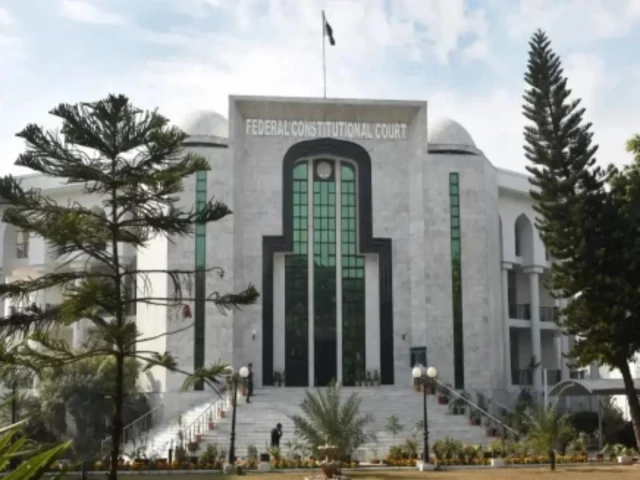
“The Federal Constitutional Court (FCC) Chief Justice Aminuddin Khan's recent step of installing a digital stopwatch in Courtroom No 1, allowing lawyers 10 minutes each to present their arguments, has …”
Despite the passage of 10 months, lawyers are also questioning why six vacant seats in the FCC have not been filled to help reduce pendency. Currently, 230,409 cases are pending in the apex court of the country.
Under the new system, lawyers representing the parties in a case will initially be given 10 minutes each to present their arguments. If more time is required in an important or complex case, the court may extend the allotted time at its discretion.
In major and significant cases, the time may be extended up to 30 minutes through a judicial order. Under the timer system, once the allotted time for a lawyer expires, the timer will automatically sound an alarm, immediately informing both the lawyer and the court that the prescribed time has ended.
"Stay connected with Aman-e-Pakistan for ongoing live reporting and verified investigative updates."
The lawyer will then be required to leave the rostrum. However, the court will retain the authority to grant additional time where necessary. Hearings of cases under this system have already started in the court of Chief Justice Aminuddin Khan.
Meanwhile, lawyers are divided over the unusual step taken by the FCC chief justice. Former law officer Waqar Rana believes that the pressure of huge pendency and a lack of credibility in the administration of justice are forcing the chief justice of the FCC to adopt such a policy.
Rana says that the right of audience before a court of law is part of the right to a fair trial under Article 10-A of the Constitution. "Judges now rely upon their inexperienced law clerks and their brief in the judgements and this practice is against the law.
The Bar Councils must agitate this matter and protect their rights. "'Justice cannot be reduced to stopwatch'Lawyer Waqas Ahmad states that speedy disposal is important, but constitutional justice cannot be reduced to a stopwatch.
"The right to a fair hearing requires that counsel be given a meaningful opportunity to present the case, particularly where fundamental rights and questions of constitutional interpretation are involved. ""Efficiency should facilitate justice, not come at the expense of effective representation and due process," he adds.
Supreme Court lawyer Hafiz Ehsaan Ahmad Khokhar observed that the introduction of a countdown mechanism for concluding oral arguments by counsel before the FCC is a constructive and modern initiative aimed at promoting time-bound hearings, disciplined advocacy and efficient disposal of constitutional litigation. Similar case-management and time-management practices are followed by constitutional and superior courts in various jurisdictions.
However, such a mechanism should facilitate effective case management rather than unnecessarily restrict the court's ability to examine substantial constitutional questions.
In view of the fact that more than 22,000 cases have reportedly been transferred to the FCC, many involving questions of considerable constitutional and public importance, there is an urgent need to increase the strength of FCC judges immediately and by a substantial number.
This expansion should include, within the constitutional framework, the appointment of highly experienced and distinguished constitutional lawyers and jurists, in addition to serving or former judges, so that the court possesses sufficient judicial capacity, diverse constitutional expertise and institutional experience to deal with its exceptionally heavy docket.
The lawyer further stated that important constitutional questions should ordinarily be heard by benches comprising at least three judges, while matters involving exceptional constitutional significance, conflicting constitutional interpretations or questions having far-reaching legal and public consequences may appropriately be placed before larger benches of around five judges, subject to the Constitution and applicable law.
Such a structure would promote broader judicial deliberation, consistency and the development of authoritative constitutional jurisprudence. "The significance of this institutional requirement is further enhanced by Article 189 of the Constitution, under which decisions of the Federal Constitutional Court, within the constitutional scheme, are binding upon all other courts, including the Supreme Court.
It is, therefore, essential that the FCC develops a coherent, carefully reasoned and enduring body of constitutional jurisprudence capable of providing clear guidance to the entire judicial system. "He also stressed the need for a transparent, predictable and well-established case-fixation, roster and bench-allocation system in accordance with the applicable constitutional and statutory framework, particularly the relevant practice and procedure law.
"Since the FCC is a specialized constitutional court, its principal registry at Islamabad should remain the central forum for hearing constitutional matters, while hearings at other registries may be arranged where genuine judicial or administrative necessity so requires," he adds.
Meanwhile, the FCC judges are also facing what some lawyers call a "battle of perception", particularly because they were appointed by the federal government, which is expected to be the primary litigant before the court in several politically sensitive matters.
Continue Reading: More in National
Swipe or click arrows to explore National desk coverage