Inside EOBI
“Back to Tribune. HomeT-Magazine. Inside EOBIT-Magazine. Next Story. Inside EOBIAn investigation into Pakistan's pension institution reveals delays, low payouts, weak oversight, and corruption. ByMuhammad Ilyas|…”
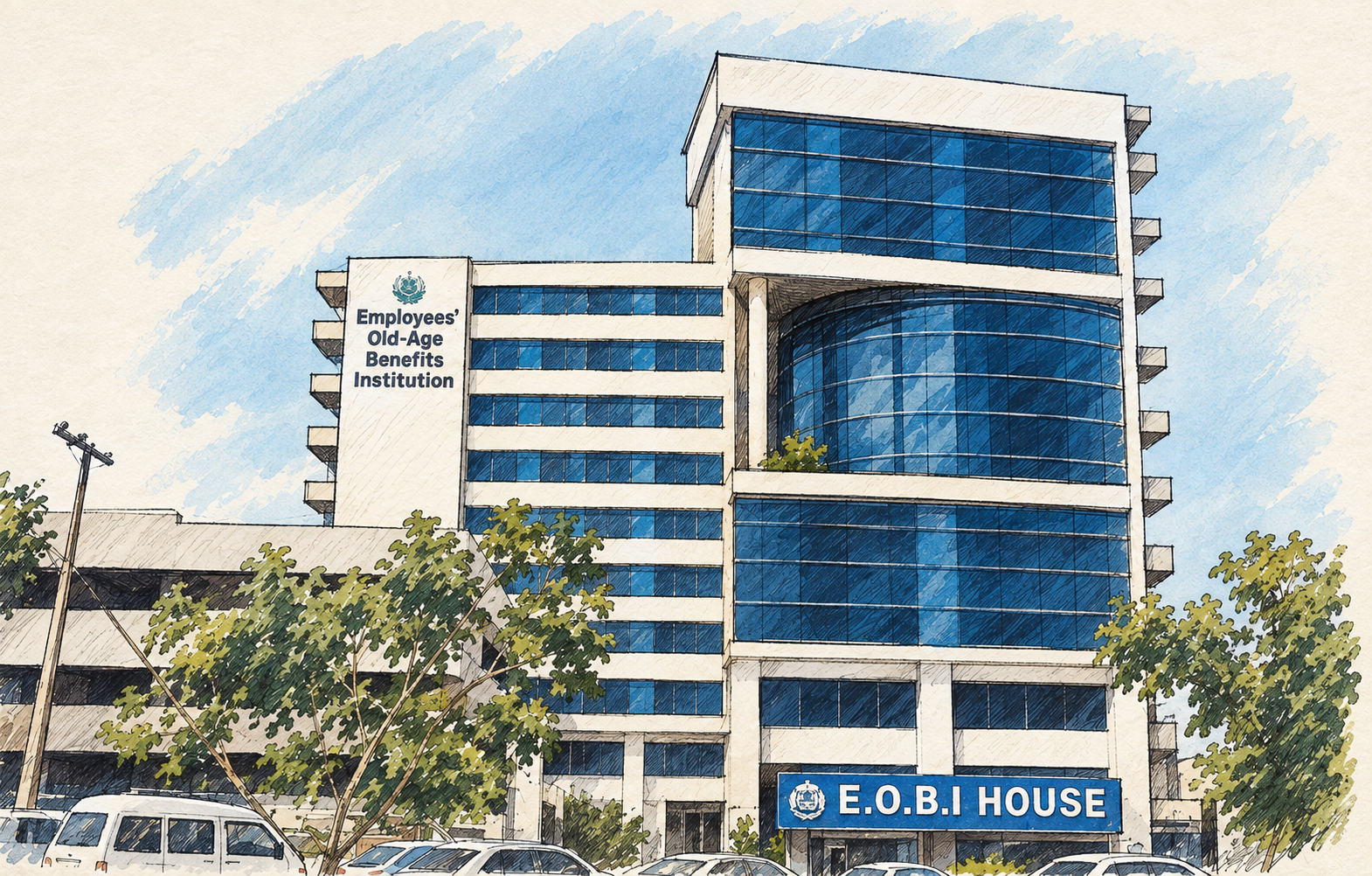
Back to Tribune. HomeT-Magazine. Inside EOBIT-Magazine. Next Story. Inside EOBIAn investigation into Pakistan's pension institution reveals delays, low payouts, weak oversight, and corruption. By. Muhammad Ilyas|Photo: AI GeneratedfacebooktwitterwhatsuplinkdedemailPUBLISHED
September 13, 2026For millions of Pakistan's private-sector workers, retirement is meant to be safeguarded by the Employees' Old-Age Benefits Institution (EOBI)—a mandatory pension scheme funded through years of contributions by employees and employers alike.
Yet for many pensioners, the promise of financial security has instead become a frustrating struggle marked by bureaucratic delays, inadequate pensions, allegations of corruption and an institution that critics say has failed to keep pace with the country's economic realities.
"Stay connected with Aman-e-Pakistan for ongoing live reporting and verified investigative updates."
An examination of EOBI's operations reveals growing concerns over governance, transparency and whether Pakistan's principal social security scheme is delivering the protection it was created to provide.
Established nearly half a century ago, in 1976, to strengthen Pakistan’s social protection system, by providing financial support to private-sector employees in old age, disability and upon death, the EOBI remains a vital source of financial security for millions of workers. Yet despite almost five decades of operation, many fundamental issues remain unresolved.
At the same time, however, the institution has long faced criticism over mismanagement, delays, investment practices, lack of transparency, allegations of corruption and administrative shortcomings. Experts say the concept behind EOBI is crucial because most private-sector employees in Pakistan are not entitled to a government pension after retirement.
As a result, millions of families depend on EOBI pensions to sustain themselves in old age. Labour leader Farooq Tariq said the institution has invested its funds in various sectors. While the official process for obtaining a pension appears straightforward on paper—with claims supposedly processed within 45 days—retired workers often face significant difficulties.
Many do not know how to apply for their pensions and are allegedly forced to pay bribes exceeding Rs25,000. Pensioners frequently wait one to two years before receiving payments. Elderly beneficiaries are also required to repeatedly visit banks to prove they are still alive before pensions are released, a process Tariq described as unnecessarily burdensome.
Social security expert and labour leader Niaz Ahmed said many employers never register their workers with EOBI, leaving them ineligible for pensions after retirement., employers often fail to assist workers once they retire. Under current rules, only employees who have remained registered for at least 15 years qualify for an EOBI pension.
Those who fail to complete the required contribution period receive nothing. Ahmed also said the institution has witnessed multiple financial scandals over the years., EOBI’s investment portfolio has grown to approximately Rs692 billion, making it comparable in size to the assets of several major financial institutions in Pakistan.
The fund is invested primarily in Pakistan Investment Bonds, government securities, fixed-income instruments, limited equity investments and certain real estate projects. Despite the size of the fund, experts question why the returns generated through these investments have not translated into significantly higher pensions.
They argue that if the institution continues to earn billions through investments, pension payments should have increased accordingly. Every registered employer and employee contributes to EOBI, creating the institution’s core fund. Those contributions are then invested in relatively secure financial instruments, with profits used alongside contributions to finance pensions for hundreds of thousands of beneficiaries.
Economist Dr Qais Aslam said that because EOBI manages public money, it should regularly disclose detailed information on its investments, annual returns, losses and overall investment performance. Greater transparency, he argued, would strengthen public confidence.
Although the law states that workers who reach retirement age and meet contribution requirements should receive pensions, in practice many applicants face serious delays. Dr Aslam said the fund could generate higher returns through broader participation in capital markets, allowing pensioners to receive additional financial support and improving their quality of life after retirement.
Many applicants say their employers failed to deposit EOBI contributions for years, leaving workers to bear the consequences. Others encounter incomplete employment records, delays in document verification, disputes over service history or legal complications, resulting in pension payments being delayed for months or even years.
Social security experts argue that workers should not be made responsible for resolving such issues. Instead, EOBI should verify employment records itself and take action against employers who fail to meet their legal obligations. For thousands of employees in the private sector, retirement often becomes especially stressful when they approach EOBI for benefits.
Some are the required contribution period, while others discover that the companies where they worked for years were never registered with EOBI. As a result, many workers lose access to pensions despite decades of service.
One applicant, identified only as Nadeem, said he had submitted his pension application more than 18 months ago but had still received no decision. Instead, he said he had been forced to make repeated visits to EOBI offices.
Elderly applicants often have to climb several flights of stairs, only to be another day. The experience, he said, has shattered their hopes. Experts recommend that the government introduce digital monitoring of all private-sector employers to ensure contributions are deposited on time and workers do not face difficulties after retirement.
EOBI’s history has also been marred by corruption allegations. Over the past two decades, several scandals have emerged involving expensive property purchases, abuse of authority, fake payments and irregularities in investments. The National Accountability Bureau, the Federal Investigation Agency and other investigative bodies have examined these cases at different times, with criminal proceedings initiated against some former officials.
Although successive governments have promised reforms, concerns remain about transparency and accountability within the institution. Another recurring concern is the prolonged absence of a permanent chairman at EOBI. The issue has been raised in the Senate Standing Committee and other forums.
Experts argue that repeated reliance on acting leadership has undermined the institution’s long-term planning and that only stable, professional and independent leadership can effectively implement reforms. EOBI’s investments currently include Pakistan Investment Bonds, government securities, fixed-income instruments, selected real estate projects and limited stock market investments.
Experts note that pension funds in developed countries typically adopt diversified investment strategies to maximise returns while reducing risk. They argue that Pakistan should also modernise EOBI’s investment approach. At present, EOBI pays a monthly pension of Rs11,500, which experts say is inadequate given current inflation.
They argue that pension payments should be adjusted to reflect the rising cost of living so retirees can maintain a reasonable standard of living. However, successive governments have failed to significantly increase pension amounts despite the institution’s substantial financial resources.
EOBI currently disburses approximately Rs72 billion in pensions annually while collecting around Rs86 billion in annual contributions from members. The institution also maintains significant investments., EOBI currently has 161,296 active registered employers, 12.19 million registered insured members, and 838,127 pension beneficiaries.
A senior EOBI official, speaking on condition of anonymity, alleged that annual audits regularly uncover collusion between company management and officials to underreport the number of registered employees. For example, he said, a company employing 100 workers may register only 40 with EOBI while falsely classifying the remaining workers, allowing contributions to be misappropriated.
This reduces the institution’s contribution income while depriving workers and their families of future pension benefits. The official also alleged that complaints of bribery have been made against several officers. Despite official rules requiring pension claims to be processed within 45 days, retired employees are often deliberately delayed and pressured to pay bribes.
In some cases, he claimed, retirees have even been deprived of their outstanding payments, with little accountability for those responsible. Nearly five decades after its creation, EOBI remains indispensable to Pakistan's social protection system, but its credibility increasingly depends on meaningful reform.
Experts agree that restoring public confidence will require stronger governance, transparent fund management, stricter enforcement against non-compliant employers, digitalisation of services and pension payments that reflect today's cost of living.
For millions of workers who have spent their lives contributing to the scheme, retirement security is not a privilege but a legal entitlement—one that EOBI can only fulfil if it is managed with accountability, efficiency and fairness. Pages.
Pakistan. Business. World.
Opinion. Life & Style. Sports.
Blogs. Videos. Our Sites.
Express News. Urdu E-Paper. English E-Paper.
Sindhi E-Paper. Cricket Pakistan. Express Live.
Campus Guru. Express Entertainment. Food Tribune.
About Us. Contact Us. Online Advertising.
Privacy Policy. Copyright. Fuel Prices Pakistan.
Gold Prices Pakistan. Prayer Timing Pakistan. Weather Forecast Pakistanfollow us
Continue Reading: More in National
Swipe or click arrows to explore National desk coverage