Where the crocodiles wait for dinner
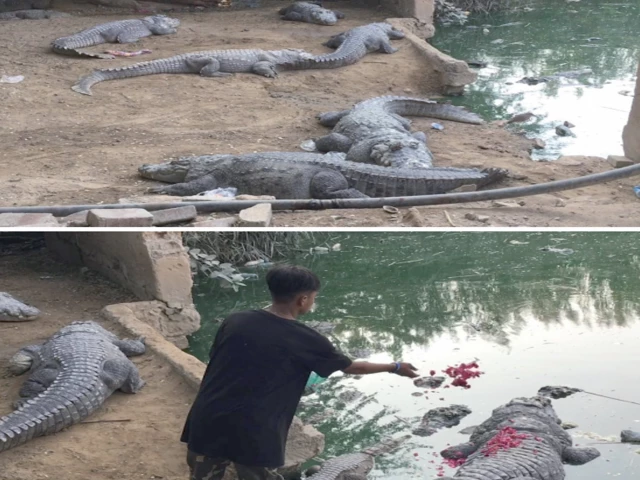
“Every Thursday, as the afternoon heat settles over the barren foothills of Manghopir, the faithful arrive with offerings in their hands. Some carry rose garlands. Some carry halwa. The luckier crocodi…”
Some carry rose garlands. Some carry halwa. The luckier crocodiles get the thing they actually want: meat.
But these days, the meat is rarer than the miracles. For generations, the pond beside the shrine of revered Sufi saint Hazrat Sakhi Sultan Shah has been one of Karachi's strangest and most beloved sights, a place where sainthood, folklore and scaly, snub-nosed reptiles share the same sacred ground.
Devotees believe the creatures are linked to the blessings of Hazrat Baba Farid Ganj Shakar. They come to make vows, to seek cures, to watch the giants bask in the mud. What they find now is a pond in trouble.
"Stay connected with Aman-e-Pakistan for ongoing live reporting and verified investigative updates."
More than 200 crocodiles share a pond of roughly 1,000 square yards, a space the shrine's caretakers say can no longer hold them. As numbers climb through breeding, so do tensions. Some of the reptiles have taken to attacking one another.
Presiding over the cramped realm is Mor Swab, the oldest crocodile, estimated by the shrine's management to be around 175 years old. Most of the others are believed to be between 50 and 70. Between them, they have outlived governments, borders and the city's skyline.
They have not, it seems, outlived the price of mutton. Khalifa Sajjad knows the numbers by heart. His family has looked after the crocodiles for three generations, and he has watched the offerings thin out.
"Back when mutton cost between Rs700 and Rs1,000 per kilogramme, devotees could afford to bring meat for the crocodiles," he said. "Today, with the price reaching Rs2,500 per kg, it has become increasingly difficult for visitors to contribute.
"The animals, being carnivores, live on chicken, beef and mutton, and for years the vows of the faithful covered much of the bill. That arrangement has quietly collapsed. Today, a Karachi philanthropist donates four cows a month, a gesture that keeps the kitchen running but falls well short of feeding a population this large.
Sajjad said repeated appeals to the Sindh government have produced no permanent arrangement. Even a modest contribution, he said, of one kilogramme of meat per crocodile per day, would bring considerable relief. Hunger is not the only worry.
Little rain has fallen in Karachi, so no fresh water has flowed into the pond, leaving it stagnant and algae-covered. Sajjad said the water's natural sulphur content keeps the smell at bay; without it, he said, standing near the pond would be unbearable.
Then there is the wall. The structure surrounding the pond has weakened at its foundations, with sections that could give way at any moment. Sajjad urged the relevant government departments to repair or rebuild it before a collapse turns into a tragedy.
It is a precarious situation for creatures that are, by tradition, pampered. Halwa is offered to them. Flower petals are showered over their backs.
During the Nauchandi gatherings and the annual Sheedi Mela, vermilion is dabbed on their foreheads and sweets are laid out in abundance. The shrine is also known for its hot-water spring, which flows from the foothills and is believed by visitors to cure skin ailments.
But it is the crocodiles, with their unusual snouts, distinct from the crocodiles and gharials found elsewhere, that have long drawn the crowds. For Karachi, the Manghopir crocodiles are more than residents of an ageing pond.
They are a living thread through the city's religious and cultural history, one stretching back nearly two centuries. Their survival now hinges on the unglamorous basics: food, clean water, room to move and a wall that stays upright.
The question hanging over the pond is a simple one. Will the authorities act to protect this heritage, or wait for a major accident or a full-blown food crisis to force their hand? For now, the crocodiles wait.
They are, after all, patient animals.
Continue Reading: More in National
Swipe or click arrows to explore National desk coverage